Things To Do In Cambodia (2026): My Honest Guide After Visiting
The Must-See Places In Cambodia
There are plenty of things to do in Cambodia, but the real question you’re probably asking is whether it’s worth going at all, or if you should just spend that time in Vietnam or Thailand instead.
My answer? Yes, but not if you’re only giving it two days. That’s the mistake I see over and over. People treat Cambodia like a quick Angkor Wat stopover between “proper” countries, fly into Siem Reap, snap the sunrise photo and leave. I think that’s lazy planning, and I know it might ruffle a few feathers to say it.
I spent almost a full month in Cambodia, covering Phnom Penh, Siem Reap, Angkor Wat and Koh Rong Samloem, the places most people come for, and I gave each one proper time.
I’ll admit I didn’t expect to fall for it the way I did. It happened on Koh Rong Samloem, walking the beach with nobody else around. Not a single person. Just sand, water and me, wondering why more people weren’t here. That was the moment Cambodia won me over.
And honestly? It still wasn’t the best part. That was Angkor Wat. I’d seen the photos a hundred times and assumed it would be one of those places that looks better online. It wasn’t. It was bigger, older and more impressive than any picture had prepared me for.
Comparing Cambodia to Thailand is a bit like comparing a local pub to a chain bar. One is polished and predictable. The other has more character, fewer crowds, and stays with you longer.
So if you’re a solo traveller trying to work out where to spend your time, or a couple wanting somewhere that doesn’t feel like everyone else’s holiday, this is for you. I’ll show you what’s worth prioritising, what you can skip, and how to make sure Cambodia gets more than a rushed two days on your route.
Disclosure: Some of the links on this page are affiliate links, which means that if you make a booking through them, I may earn a commission. See my Privacy Policy.
Royal Palace And Silver Pagoda
I’ll be honest, I never actually made it inside the Royal Palace, and I’m still a bit annoyed about it.
It was my fault for arriving in the wrong clothes.
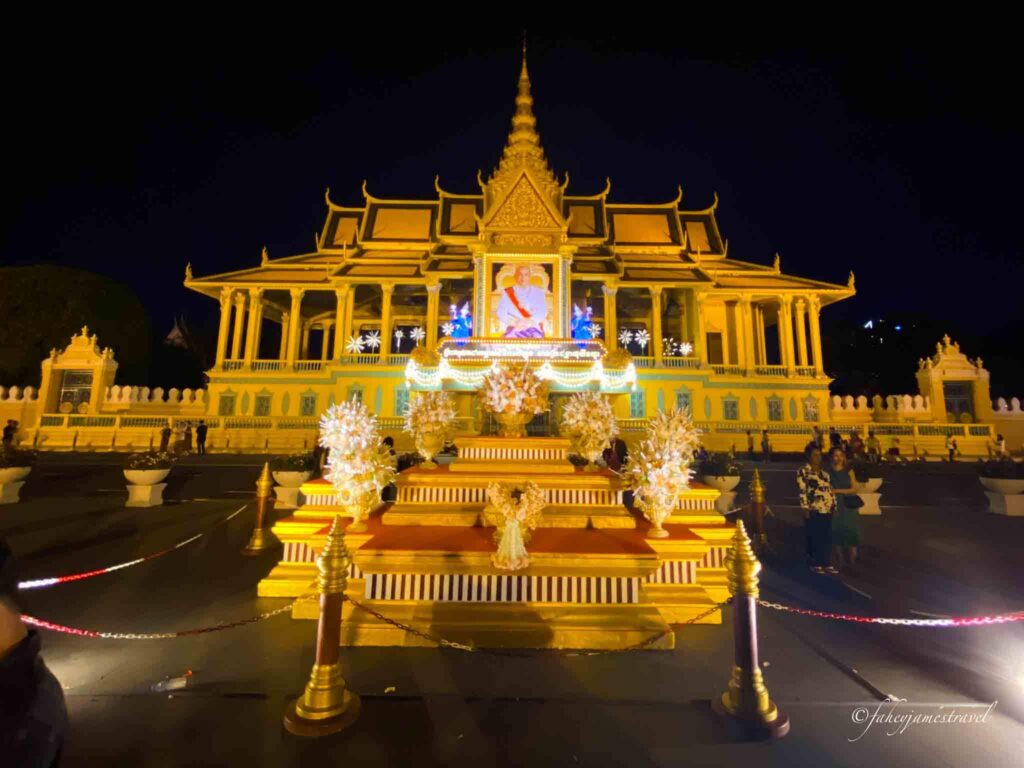
You need to cover your shoulders and knees. Although I planned to return, I never got the chance. The Royal Palace and Silver Pagoda are two of the main attractions in the capital.
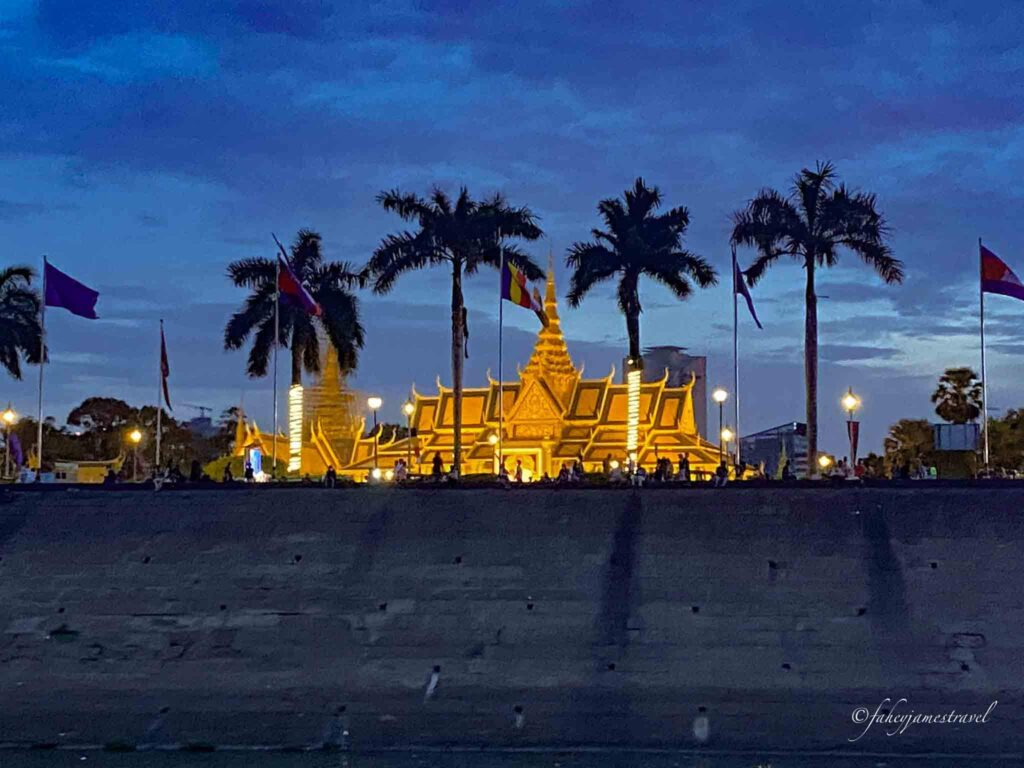
I could only see the palace from outside, but its golden roof rose above the walls and was easy to spot from the river. Its 59-metre spire looked impressive, even at a distance. Interestingly, the four faces on top of the spire were inspired by Bayon, an Angkor-era temple built centuries earlier.
The Silver Pagoda is inside the palace grounds, so you can visit both at the same time. The official name of the Silver Pagoda is Wat Preah Keo Morakot, meaning the “Temple of the Emerald Crystal Buddha”.
The roof is covered in beautiful gold leaf and has a striking glow. From what I read online, the Silver Pagoda has two stupas and a golden temple in the centre. There are more than 5,000 silver tiles, each weighing over one kilogram.
It closes at midday, so plan your itinerary around the break.
The Emerald Buddha is not actually made from emerald.
It is a Baccarat crystal Buddha dating from the 17th century, with a deep green colour. You will not see much silver, but there is a life-size gold Buddha. It is decorated with 9,584 diamonds, the largest weighing 25 carats.
The Silver Pagoda was built in 1892 under King Norodom, then rebuilt in its current form in 1962. But you cannot take pictures inside the Silver Pagoda. You must also remove your shoes before entering.
Learn from my mistake and pack something that covers your shoulders and knees as a scarf won’t cut it.
- Cost: KHR 40,651 ($10.00/€8.84/£7.55)
- Opening Hours: 08.00 AM to 11.00 AM and 02.00 PM to 05.00 PM daily
- Suggested Duration: 1.5 to 2 hours
- Address: Samdach Sothearos Blvd (3), Phnom Penh
☕️Read This Guide About The Best Coffee Spots In Phnom Penh☕️
S-21 (Tuol Sleng Genocide Museum)
The photographs are what I remember most about S-21.
Row after row of faces looked straight back at me.
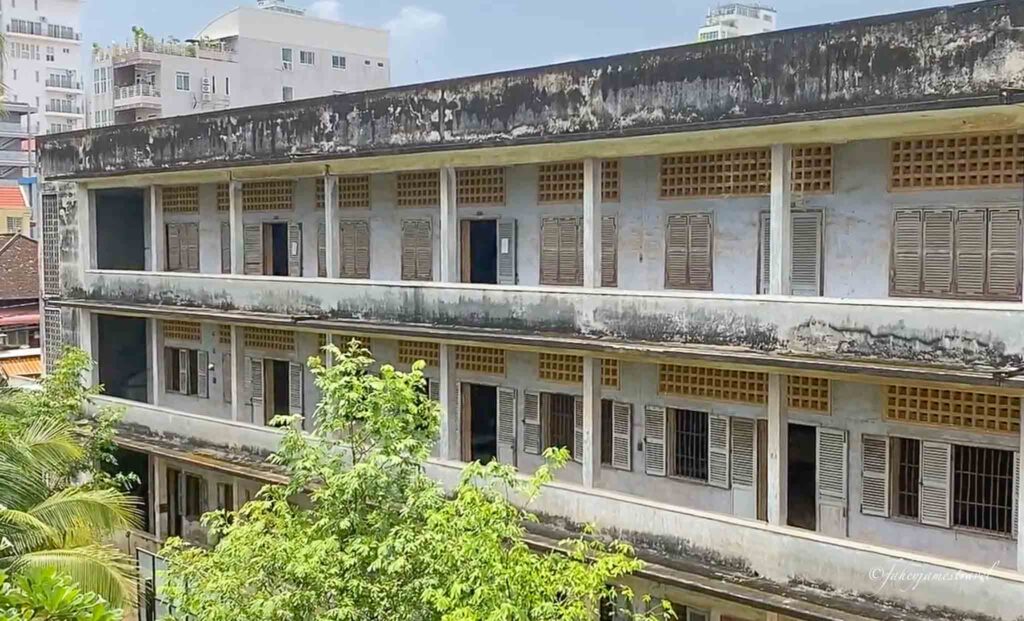
What hit me hardest was how much the rooms resembled those in any school in my country. The large courtyard had green trees, with three main buildings surrounding it.
I walked slowly along the corridors with the doors open. The sheer number of rooms made me realise how many victims had been tortured there.
I thought the audio guide was well worth the fee of ($5.00/€4.42/£3.77). It explained what I was seeing and shared the personal stories of the people who were held there.
You could spend two hours here taking in the stories and understanding this important part of Cambodia’s history. I arrived at around 10.00 AM.
Although other people were there, it was not too busy.

Visiting S-21 before the Killing Fields made sense.
I heard the victims’ stories here, then saw their grave sites afterwards. It was an emotionally draining day, and the reality of Pol Pot’s impact was hard to ignore.
There were signs saying no photos or videos, but honestly, most people ignored them. I barely heard anyone speak. Everyone held the audio guide close to their ears and walked around like zombies, with no smiles or emotion.
There was a stated age restriction, although I saw young teenagers during my visit. I would allow some time for reflection before leaving so you can process the prison’s story.
If you only have one day in Phnom Penh, spend part of it here.
- Cost: KHR 20,326 ($5.00/€4.42/£3.77), plus KHR 20,326 ($5.00/€4.42/£3.77) for the audio guide, cash only
- Opening Hours: 08.00 AM to 05.00 PM daily
- Suggested Duration: 1.5 to 2 hours
- Address: St. 113, Boeung Keng Kang III, Phnom Penh
🇰🇭 Discover The Best Things To Do In Phnom Penh 🇰🇭
Choeung Ek Killing Fields
After S-21, I thought I knew what to expect at Choeung Ek, but I didn’t.
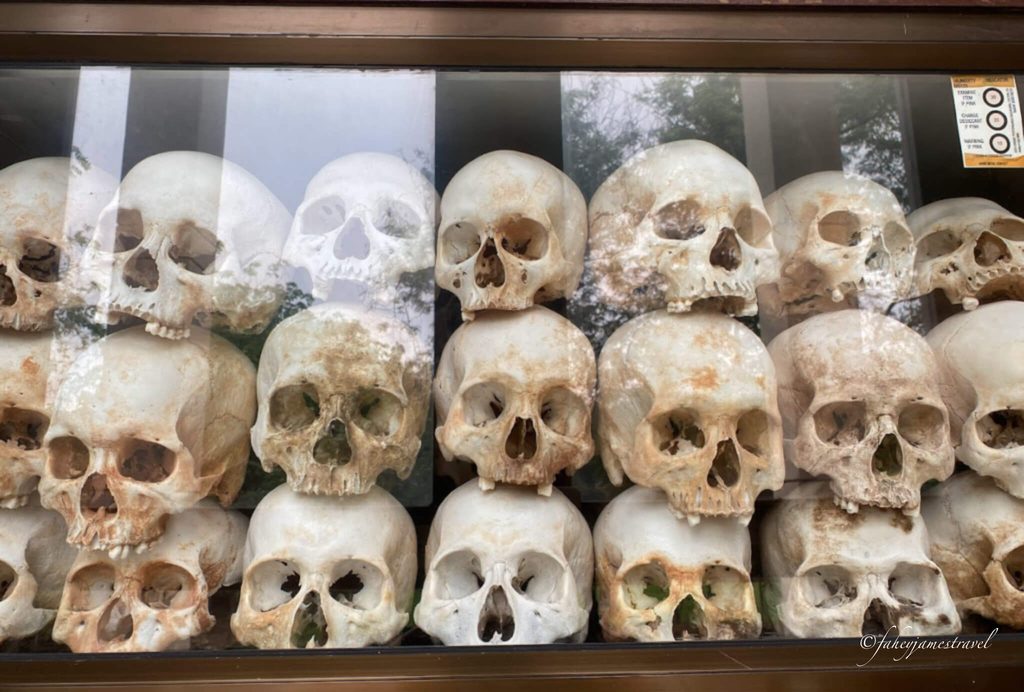
The stack of skulls staring directly at me through the glass was striking.
More than 5,000 skulls are housed inside the stupa.
Before the brutalities took place here, the site was an orchard and a Chinese burial ground. When Pol Pot took over, it became hell. Surprisingly, it felt peaceful and calm as I walked around, which was nothing like I expected.
I came here after visiting S-21, and seeing both helped me piece the story together. I saw bones in the ground, victims’ clothing and pits where bodies had been dumped. Stay on the walking path.
My tuk-tuk driver waited for me outside. A return trip to the city normally costs between KHR 60,977 and KHR 81,302 ($15.00 to $20.00/€13.25 to €17.67/£11.32 to £15.09). If you are on a budget, take the 11B bus for KHR 1,500 ($0.37/€0.33/£0.28), which is very affordable.
You can take a group tour from the city. I suggest this tour because it includes water, hotel pickup and the entrance fee.
As at S-21, using the audio guide is essential for understanding the key information. Do not skip it when it is included in the ticket.
I arrived at 01.00 PM and stayed until 03.30 PM, so allow plenty of time here.
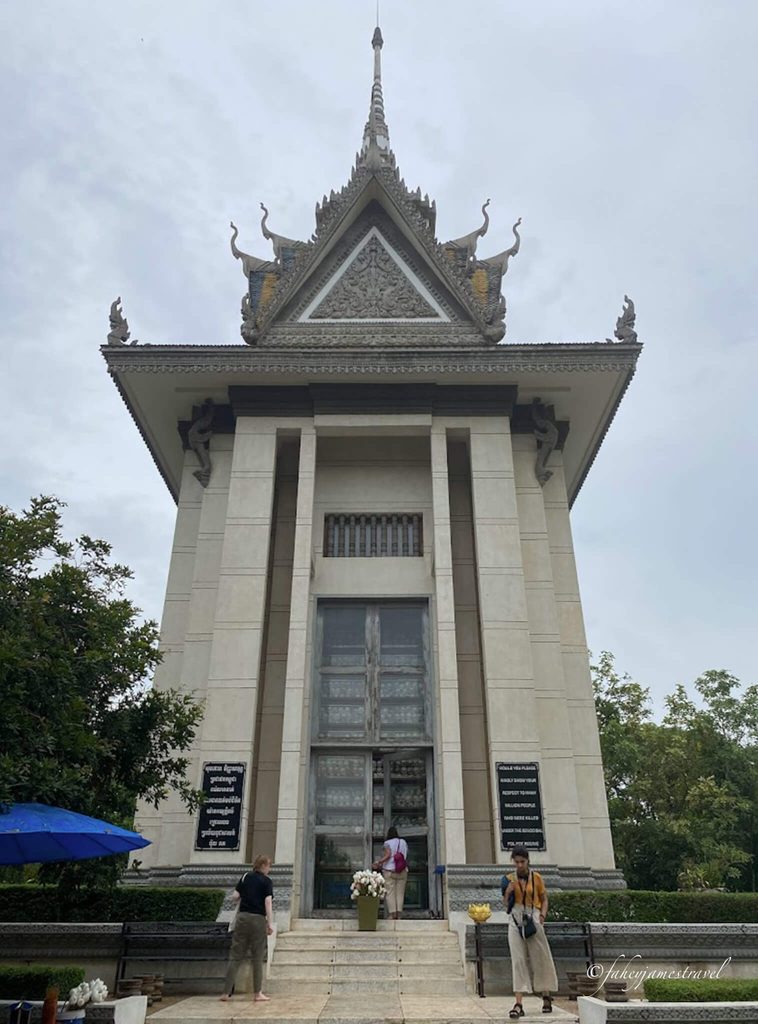
You cannot expose your back or wear shorts here.
I saw several signs around the entrance explaining the dress code. It may seem obvious, but do not pose for photos and smile. That would be in bad taste.
You can also visit the museum about the regime and the efforts to convict those responsible. If you visit in May, as I did, the annual memorial ceremony takes place on 20 May. I was so annoyed that I was too early.
Visit after S-21 if you can, so the story makes sense in order.
I’ll be honest, I felt like crap after visiting, but a few days later I was glad I understood the country better.
- Cost: KHR 24,391 ($6.00/€5.30/£4.53), including the audio guide
- Opening Hours: 07.30 AM to 05.30 PM daily
- Suggested Duration: 2 to 3 hours
- Address: Roluos Village, Sangkat Cheung Aek, Phnom Penh
Silk Island Tour
After two days of Khmer Rouge history, Silk Island (Koh Dach) was exactly the change of pace I needed.
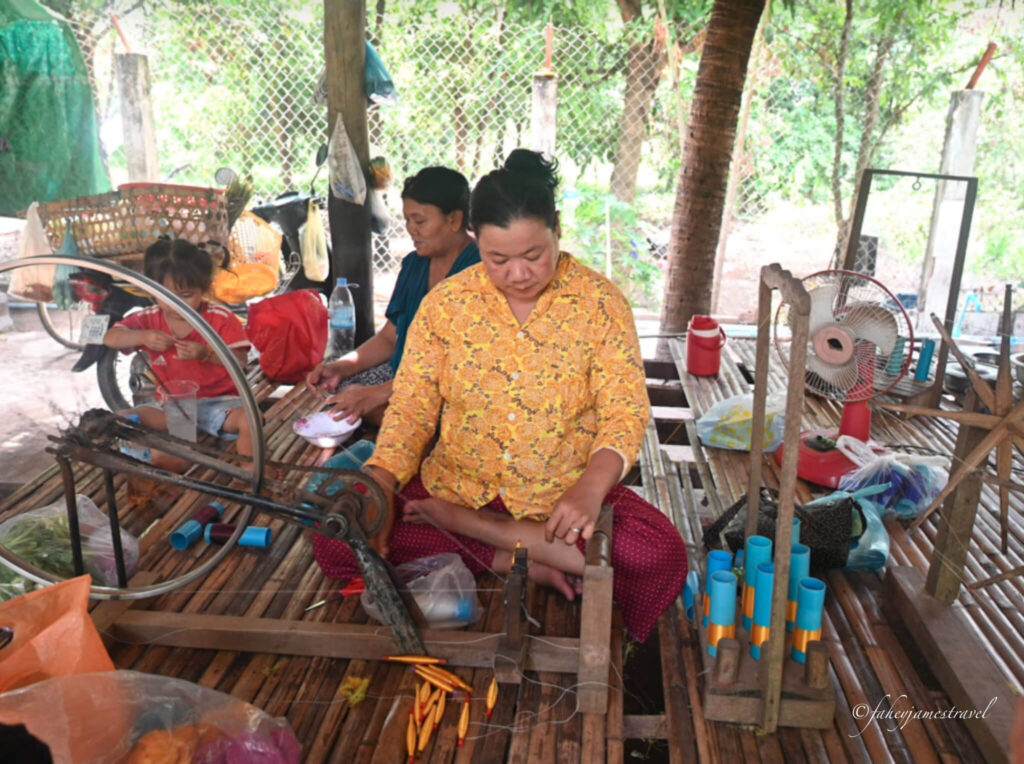
After being turned away from the Royal Palace, I found a tuk-tuk driver who offered to take me to Silk Island.
I paid KHR 105,693 ($26.00/€22.97/£19.62) for a five-hour tour that included Silk Island, the Golden Temple and more.
I thought it was worth it because the driver shared information about Phnom Penh and its history and helped me get around quickly.
Watching a woman use a spinning wheel and loom was fascinating.
It was interesting to see how the scarves and other garments were made. It did not look comfortable to do all day, but that is the reality of silk production. The woman told me that young people now leave to work in factories, making weaving far less common and less economically viable.
The ferry crossing was fine. I had to get out of the tuk-tuk and let my guide drive it onto the ferry; otherwise, I might have fallen out. The pier was muddy and wet, so it was safer to get out.
The main weaving centre is on Koh Okhna Tei, linked to Koh Dach by a small bridge.
On Silk Island, my guide drove me around, and I only walked through the Silk Island community centre. If you don’t want to take the tour but still want to visit Silk Island, take the Japanese Bridge and National Road 6 to the ferry. Overall, it takes around 45 minutes to an hour to get there.
To be honest, I did feel pressured to buy a few things at the shop, so I did. It cost KHR 60,977 ($15.00/€13.25/£11.32) for a silky purple scarf.
The tour ran from 10.40 AM to 03.30 PM. I also visited places such as Wat Phnom Daun Penh and Wat Sampov Treileak.
One downside was meeting children who asked me to take selfies with them, then asked for money. It felt staged, and it made me sad to think they knew what to do.
Overall, though, it felt like a much more easy-going experience after visiting S-21 prison and the Killing Fields.
You’ll leave knowing how much work goes into a single silk scarf, and like me, you’ll probably leave with one too.

- Tour Cost: KHR 105,693 ($26.00/€22.97/£19.62)
- Getting There: Tuk-tuk across the Japanese Bridge and along National Road 6 to the Koh Dach ferry
- Suggested Duration: Half a day
- How I Booked It: In the street, but best to book here
Koh Rong Samloem
Koh Rong Samloem is quieter than its bigger neighbour, and that’s exactly why I chose it.

I stayed on Saracen Bay because it looked like the best option and had the most restaurants, bars and piers for tours.
Lazy Beach (barely anybody around) and M’Pai Bay village ( mostly locals) felt very different. I paid KHR 180,609 ($44.43/€39.26/£33.53) per night at Sara Resort and it was worth every penny.
Be aware that damaged notes or notes marked with pen may not be accepted. I experienced this on Koh Rong Samloem, and suddenly my money felt worthless. Cash was the most common payment method, although I could pay by card at places such as the Sara Resort restaurant. Make sure you bring enough cash as a backup.
The ferry from Sihanoukville was flawless in both directions. I booked through my hotel, but I recommend booking online. The cost is KHR 69,009 ($16.98/€15.00/£12.81) one way.
What I loved was that the ferry dropped me at Soon Noeng Pier, where a motorboat came along the beach to collect me. I could have walked, but it felt like good service.
The best parts were snorkelling, relaxing and exploring.
I wish I’d taken a bioluminescent plankton tour, but I did hike to the viewpoints, find the stone carvings and enjoy the superb beaches.
Saracen Beach felt like the most modern option.
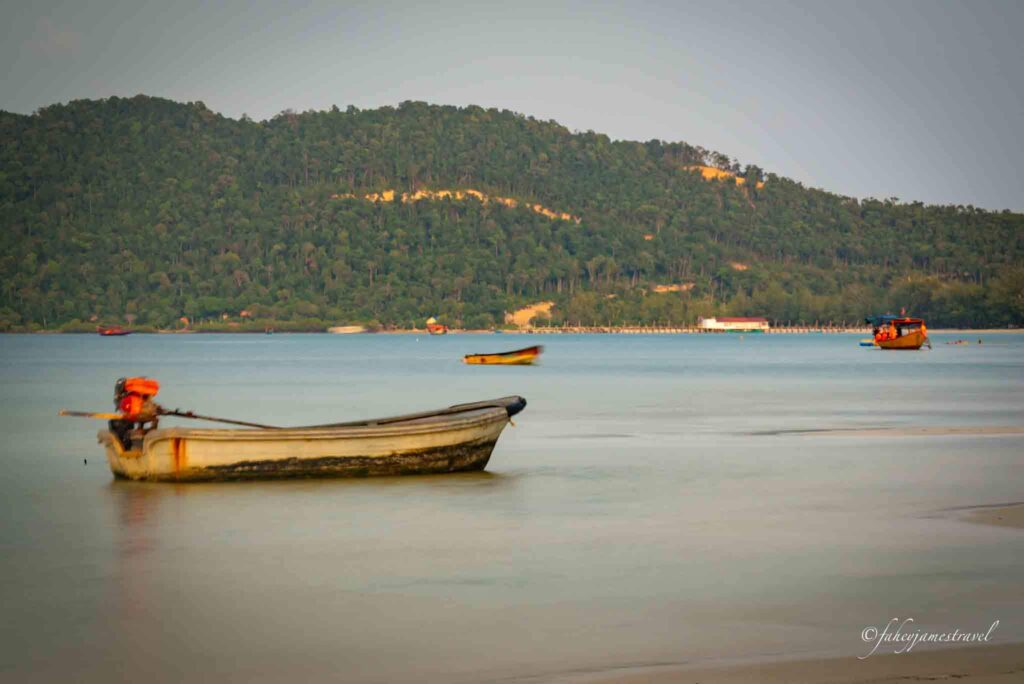
A couple I met who stayed on Lazy Beach said they had no Wi-Fi and that it felt more off grid, so you can choose based on your preferences.
One thing I did not like was the rubbish and fuel in the water where we were swimming for a couple of days. It made the experience harder to enjoy for a while, but somehow it disappeared a few days later.
I stayed for 12 nights, and it was easily enough. I chose Koh Rong Samloem over Koh Rong because I wanted a peaceful, castaway atmosphere where nobody else would be around. Although there were plenty of other people, I still felt like I got that experience.
After months of travelling in Asia and visiting some of the region’s beach islands, it was up there with the best.
It’s the kind of island where you lose track of the days, and that’s the point.
- Getting There: Speed ferry from Sihanoukville, about 45 minutes to an hour
- Ferry Cost: KHR 52,846 to KHR 69,107 ($13.00 to $17.00/€11.49 to €15.02/£9.81 to £12.83) one way
- Suggested Duration: 3 nights at least
- Where I Stayed: Sara Resort
🏖️ Read My Lazy Beach Guide On Koh Rong Samloem 🏖️
Pub Street
Pub Street is loud, neon and very touristy, and I still ended up there more than once.

It’s worth visiting at least once for the atmosphere.
A beer here isn’t especially cheap, depending on where you go. I liked Temple Pub Sports Bar, especially the seats on the street. I paid 20,830 KHR ($5.00/€4.39/£3.76) for a juice.
Pub Street feels completely different by day and night. At midday, it was almost empty, and nobody tried to entice me inside. At night, it was hectic, with loud music and people pulling you towards their bars.
It felt like Cambodia’s version of Bangla Road in Phuket, which isn’t for everyone. I stayed at Blossoming Romduol Boutique, a short walk from Pub Street, and I recommend it. You can visit the Siem Reap Night Market, then head to Pub Street for a drink after dinner.
Just don’t plan a late night before an Angkor Wat sunrise.
- Cost: Free to walk
- Best Time: Evenings, once the street closes to traffic
- Suggested Duration: 1-2 hours
- Address: Pub Street, Old Market area, Siem Reap
🇰🇭 Discover The Best Things To Do In Siem Reap 🇰🇭
Angkor Botanical Garden
After days of stone, heat and crowds, a free garden on the road to Angkor Wat was exactly the break I needed.

I got here by tuk-tuk from the city centre, which cost just KHR 12,195 ($3.00/€2.65/£2.26).
One of my favourite moments was holding hands with a gibbon that was being kept in a cage before its release. Of the five themed sections, I liked the medicinal plants and spices the most.
I also got to feed some fish and ostriches.
I visited around 11.00 AM, which worked out well because there were only a few other people around. It felt almost like I had the place to myself.
You’re not allowed to bring plastic bottles into the garden, which is a great way to keep it clean. The 14-hectare site would look terrible with lots of plastic on the ground.
I recommend combining it with the Angkor National Museum, which is only a 26-minute walk away. In the heat, you can take a tuk-tuk for a small fee.
The garden is relatively new. It opened in May 2022, so it was only a year old when I visited, and many of the plants were still small.
Families, couples and solo travellers can all enjoy this outdoor space, but if you’re after adventure and adrenaline, I’d give it a miss. It’s also the first thing I’d cut from a short trip because there are better things to see.
It did exactly what it said on the tin.
- Cost: Free
- Opening Hours: 08.00 AM to 06.00 PM, closed Mondays
- Suggested Duration: 1 to 2 hours
- Address: Charles de Gaulle Boulevard, opposite the SOS School, Siem Reap
🇰🇭 Read My 2 Week Itinerary For Cambodia 🇰🇭
Angkor National Museum
The Angkor National Museum is the context I didn’t know I needed before seeing the temples.

It was completely worth the entrance fee.
Perhaps unsurprisingly, the Gallery of 1,000 Buddhas impressed me the most. I always take an audio guide when one is available, and here it helped me understand each section clearly. Don’t skip it.
I spent three hours here, which tells you how interesting I found it. I arrived at 01.00 PM. The museum gave me a better understanding of Angkor’s history and its rulers, with plenty of artefacts to see along the way.
The building had wide corridors and plenty of natural light. By the round staircase, I ran into what looked like an entire school group. The children came up to say hello one by one, which was loads of fun.
If there had been no school group, the museum would have felt almost empty. It was cool inside too, which was a welcome escape from the humidity outside. I took a tuk-tuk there from Wat Preah Prom Rath, and it cost around KHR 12,195 ($3.00/€2.65/£2.26).
There was so much to see that I got tired and didn’t have the energy to read all the text, which was a pity. I took in as much as I could. If you get tired, I recommend focusing on the Gallery of 1,000 Buddhas, Gallery D about Angkor Wat, and Gallery C about the Great Khmer Kings.
You can buy tickets at the entrance, but buying online lets you skip the queue when it’s busy.
Visit the day before you see the temples so you can retain the information and understand the complex as you explore it.
You can also combine your visit with the botanical garden, as the two are close by.
- Cost: KHR 48,781 ($12.00/€10.60/£9.06), plus KHR 20,326 ($5.00/€4.42/£3.77) for the audio guide
- Opening Hours: 08.30 AM to 06.00 PM daily (until 06.30 PM from October to March)
- Suggested Duration: 1.5 to 2 hours
- Address: No. 968 Vithei Charles de Gaulle, Siem Reap
Banteay Srei
I’ll be honest, I nearly left Banteay Srei out because of the distance, but I’m glad I didn’t.

It was easily one of my favourite temples.
The tuk-tuk ride felt like we were heading into the middle of nowhere. To be fair, it was almost 21 kilometres from Angkor Wat.
I visited around 11.30 AM, when only a handful of other travellers were exploring, which I liked.
The outdoor exhibition/museum had plenty of information about the temple, which made exploring it more interesting. The stone was orange and brown, and the ground was dusty. I spotted Khmer writing carved into the stone, along with images of women (devatas).
A few showers during my visit darkened the orange stone, making the temple look even more impressive as I walked through it in May.
It was much smaller than Angkor Wat and Bayon.
The 10th-century temple is Hindu. Be aware of scams. I read online that someone was charged KHR 40,651 ($10.00/€8.84/£7.55) to enter despite already having an Angkor pass. While I was walking outside the World Monuments Fund Visitor Centre at Preah Khan, an official offered to take a photo, then asked for money afterwards. I felt scammed, and it left a sour taste.
It’s further out, but it’s the temple I’d point you to if you want something different from Angkor Wat.
- Cost: Included in the Angkor pass
- Opening Hours: 07.30 AM to 05.30 PM daily
- Suggested Duration: 1.5 to 2 hours, plus travel
- Distance From Siem Reap: 25 to 32 km, 45 to 60 minutes by tuk-tuk
Bayon And Ta Prohm
If Angkor Wat is the headline, Bayon and Ta Prohm are the places you’ll talk about afterwards.
Bayon
As I pulled up to Bayon in the moving tuk-tuk, I immediately saw the faces and smiled.

I found a guide waiting outside and paid him KHR 20,208 ($5.00/€4.42/£3.77) to show me around for about an hour.
His English was good, and he explained the temple’s history and what I was looking at. There were loads of people when I visited at around 09.30 AM, which surprised me.
The guide was worth it for his knowledge and detailed explanations. He showed me the bas-relief galleries depicting daily life when the empire was at its peak.
The 54 towers, each with four faces, impressed me. However, around 200 of the original 216 faces survive today.
Who the faces represent is debated. Some academics argue that they depict King Jayavarman VII or Avalokiteshvara, the bodhisattva of compassion, while some locals believe they represent Brahma.
My favourite was the large face where my guide photographed me with my face and the temple’s face looking directly at each other.
Ta Prohm
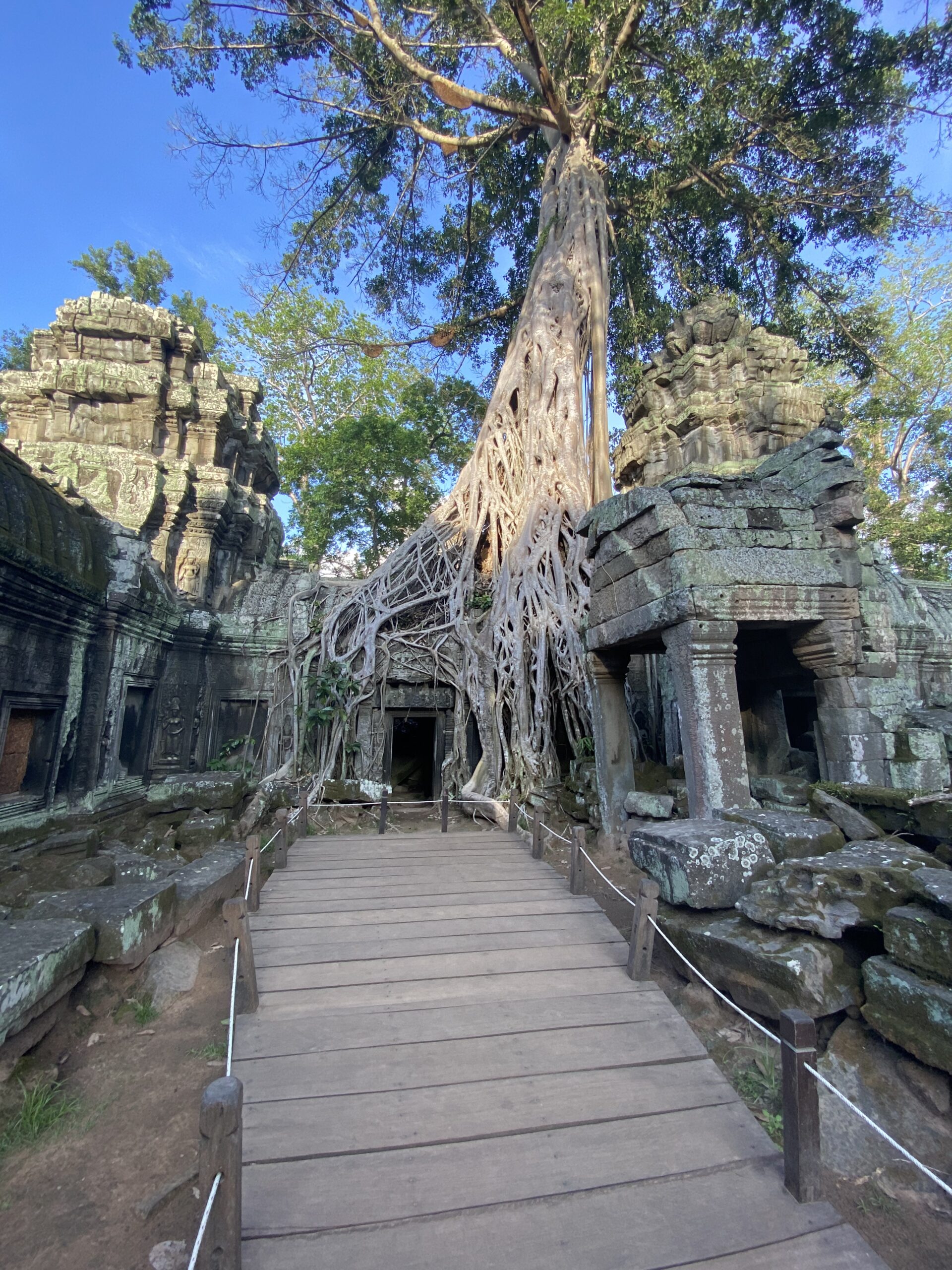
The huge, overgrown tree was the most impressive sight.
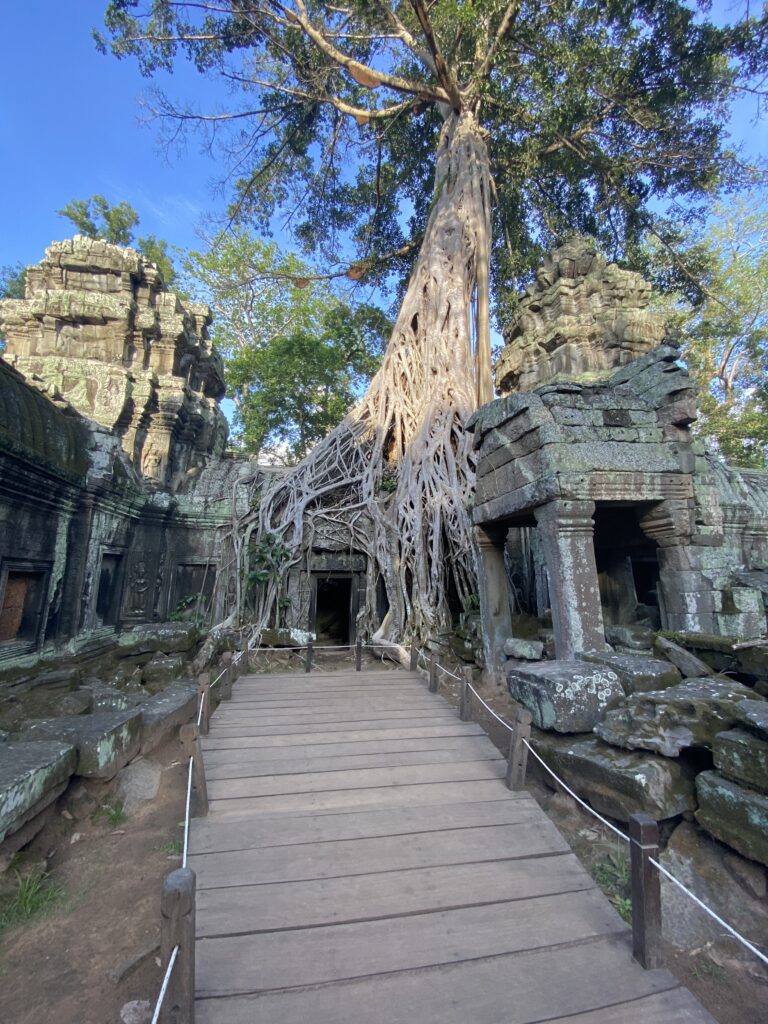
I know there are plenty of them, but this one felt special.
The trees are around 400 years old and were made famous by the Tomb Raider film. I visited at around 04.30 PM, and there were only a handful of people wandering around.
I preferred Ta Prohm because it felt bigger, and its trees won me over more than Bayon’s. Both are worth visiting.
Compared with Banteay Srei, it felt far bigger and more impressive. Both temples were built by King Jayavarman VII in the late 12th and early 13th centuries. I later discovered that Ta Prohm was built as a Buddhist monastery and university.
If you visit first thing after opening, you’ll see the light fall across these temples while everyone else heads to Angkor Wat. If you have a three-day or seven-day pass, you could try visiting on different days for sunrise and sunset.
Go early or late in the day to dodge the biggest groups.
- Cost: Included in the Angkor pass
- Opening Hours: 06.30 AM to 06.00 PM daily
- Suggested Duration: 2 to 3 hours for both
- Getting Between Them: Short tuk-tuk ride. Bayon sits at the centre of Angkor Thom, and Ta Prohm is about 1 km east of the city walls
Angkor Wat At Sunrise
I’d wanted to see the sun come up over Angkor Wat for years, and it still managed to beat my expectations.
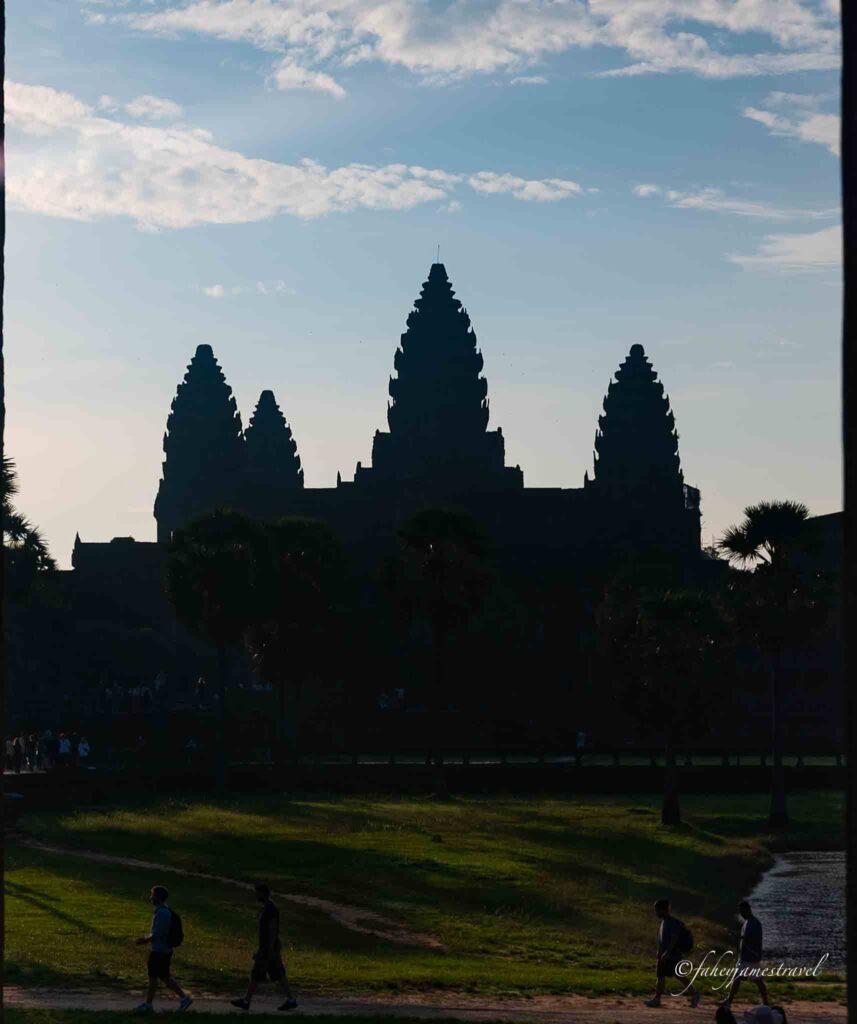
On the eastern side of the southern library, I found a window frame that offered a view to remember.
There was no glass, and you did not need it. Seeing Angkor Wat with the sunrise behind it was the standout moment of my time in Cambodia. The clouds and pink sky made it even more special.
I left my hotel in a tuk-tuk at 04.00 AM and was standing inside the Angkor Wat complex, ready to take photos, by 05.30 AM.
I paid KHR 60,977 ($15.00/€13.25/£11.32) for the tuk-tuk for the day.
After taking photos of the sunrise with thousands of other people at the reflecting pool, we moved around to the southern and northern libraries.
Once the sun had risen, I explored the perimeter wall and discovered the Churning of the Sea of Milk Gallery, Northern Thousand God Library and Chey Non Stupa.
I would have checked the weather forecast beforehand and hoped for a better sky. It was good, but not great. I also disliked how many people walked in front of me and took photos as though I wasn’t there. There are no rules against it, but I felt that some common courtesy was missing.
This was easily the best part of my month in Cambodia.
If you only do one thing here, make it this.
- Cost: 1-day pass KHR 150,409 ($37.00/€32.69/£27.92), 3-day pass KHR 252,036 ($62.00/€54.78/£46.79), 7-day pass KHR 292,687 ($72.00/€63.62/£54.33)
- Sunrise Access From: 05.00 AM
- Suggested Duration: 3 to 4 hours, including sunrise
- Address: Angkor Archaeological Park, Siem Reap
Things I Didn’t Get To Do (But Would Next Time)
Even though I spent almost a month in Cambodia, there were still brilliant places I missed.
After looking online, I know I need to revisit. Here are the places I missed and would visit next time.
Bioluminescent Plankton On Koh Rong Samloem
I’ll hold my hands up; I never saw the bioluminescent plankton.

I was told I could see some along Saracen Bay, but I had no luck.
You can take a boat tour a little further out from the island and combine it with snorkelling and fishing. I did take a daytime fishing tour, and watching the sunset with a beer was great fun.
Sadly, there was no visible plankton when I walked along the sand.
Next time, I’m booking it on my first night, not leaving it to chance.
- Best Time To See It: After dark, from 08.00 PM to midnight, on a moonless night, ideally between November and May
- Tour Cost: KHR 40,651 ($10.00/€8.84/£7.55) for a local boat trip, or free if you walk out from the beach
- Where To Book: Through your accommodation, the tour stalls on the beach, or book ahead here
Tonle Sap Floating Villages
I didn’t make it out to Tonle Sap, but it’s one of the trips I’d plan properly next time.
I ran out of time, but I’d love to see how daily life here compares with the 4,000 Islands in Laos, where life moved slowly and people depended on the river for their livelihoods.
From what I found online, Kompong Khleang is the place to go rather than Chong Kneas. You can expect to see floating houses and stilt houses, like those I saw in Koh Lanta Old Town in Thailand. They were fascinating to see in person.
Check what’s included in your tour before booking. Some people reported paying entrance fees on top of the tour price, which isn’t a nice surprise when you’re on a budget.
Allow a full day, with an hour’s drive each way, then 4 to 7 hours on the tour depending on whoch tour you take.
If sustainability matters to you, choose a community-led operator. Avoid giving money to children who beg. I learnt this the hard way in Phnom Penh when I gave them money, then later read that it can keep them trapped in poverty and begging. I felt awful afterwards.
The experience can be very different in the dry and wet seasons. Water levels drop when there’s little rain, so the time of year you visit will shape what you see.
It’s top of my list for a return trip to Siem Reap.
- Tour Cost: From KHR 266,835 ($65.64/€58.00/£49.53) for an all-inclusive group tour
- Which Village: Kompong Khleang, not Chong Kneas
- Tour Length: 5.5 to 7 hours, including the drive from Siem Reap
- Where To Book: book a Kompong Khleang tour here
Phare Circus
Phare Circus kept coming up while I was in Siem Reap, and I never made it.
After almost a month in Cambodia, I wanted to see a different side of the country. Not just temples and history, though I did enjoy those parts.
I’ve read that it’s more like a theatre performance than a circus, with young Cambodian artists. You can expect drama and live music telling stories, which sounds so interesting.
The good news is that buying a ticket supports Phare School, which helps young people work in the arts. It’s also a way to support sustainable tourism.
Try to book Section B for the best views. It’s a little more expensive than Section C, but you may not be able to see the whole stage from Section C.
Get there half an hour before the show starts. If you’re late, you won’t get in. It’s important to book ahead, as tickets usually sell out. To make the most of the experience, get street food and drinks nearby, available from 05.30 PM.
Don’t use a camera flash. Make sure it’s switched off, then fire away.
- Ticket Cost: From KHR 73,172 ($18.00/€15.90/£13.58) for Section C, or KHR 113,823 ($28.00/€24.74/£21.13) for Section B
- Show Times: 08.00 PM nightly, with extra 05.00 PM shows on some dates
- Show Length: 1 hour, plus time to meet the artists afterwards
- Address: Ring Road, south of the Sok San Road intersection, Siem Reap
What I Would Skip
There is honestly not much I would skip.
Silk Island Tour
One thing to skip would be the Silk Island tour from Phnom Penh.
It was an enjoyable experience, and I liked seeing how silk was produced. However, in hindsight, I would have visited the Royal Palace instead if I’d had the right clothes. Missing it felt like a mistake. Skip if you are short on time.
A 2nd Night On Pub Street
One night is honestly enough.
It was fun at first, but later it felt a little seedy and chaotic. Unless you’re there to party, you probably won’t want to spend several nights on Pub Street. Staying out late can also leave you too tired to enjoy the next day’s exploring.
Angkor Botanical Garden
If you’re short on time, I’d cut this, though it would be easy to keep it in your itinerary.
If your time in Cambodia is limited, the garden isn’t essential. You can find similar gardens across Asia, and I think your time would be better spent elsewhere, perhaps at Angkor Wat, on Koh Rong Samloem or in Phnom Penh.
🇰🇭 Read About The Best Spas In Phnom Penh 🇰🇭
Places I Wish I’d Visited
My route covered Phnom Penh, Koh Rong Samloem and Siem Reap. That left a lot of the country for another trip.
Kampot
Kampot kept coming up when I spoke to other travellers.
It’s a slower riverside town, and after Phnom Penh, it sounds like a haven. Pepper is one of Cambodia’s most famous products, and you can visit the farms in Kampot to see how it’s produced. Because it’s close to the coast, I could have swapped some of my time on Koh Rong Samloem for a visit here. But it’ll have to wait until next time.
Kep
Kep is a short distance from Kampot.
The crab market is the best thing to see here. You could also take a boat to Rabbit Island. Kep was a French colonial seaside resort town. Visit Kep National Park for some nice hiking trails.
Battambang
This town is famous for its bat caves and bamboo train.
Phare school actually started in Battambang. The town is supposed to be far more laid-back than Siem Reap or Phnom Penh.
Kratie
The main attraction is seeing the Irrawaddy dolphins found in the Mekong River in northern Cambodia.
They used to be found around the 4,000 Islands in Laos too, but not any more. It’s further up the same river, and the dolphins no longer travel that far. I could potentially see them in Kratie instead.
Koh Rong
The larger island of Koh Rong is said to have wonderful beaches too.
With more activities and places to stay, it would offer a very different experience from the smaller island I stayed on.
If you’ve been to any of these, I’d love to hear what I missed.
🇰🇭 Read About My 3 Day Itinerary For Siem Reap 🇰🇭
When To Visit Cambodia
The best time to visit Cambodia is from November to February, during the dry season.
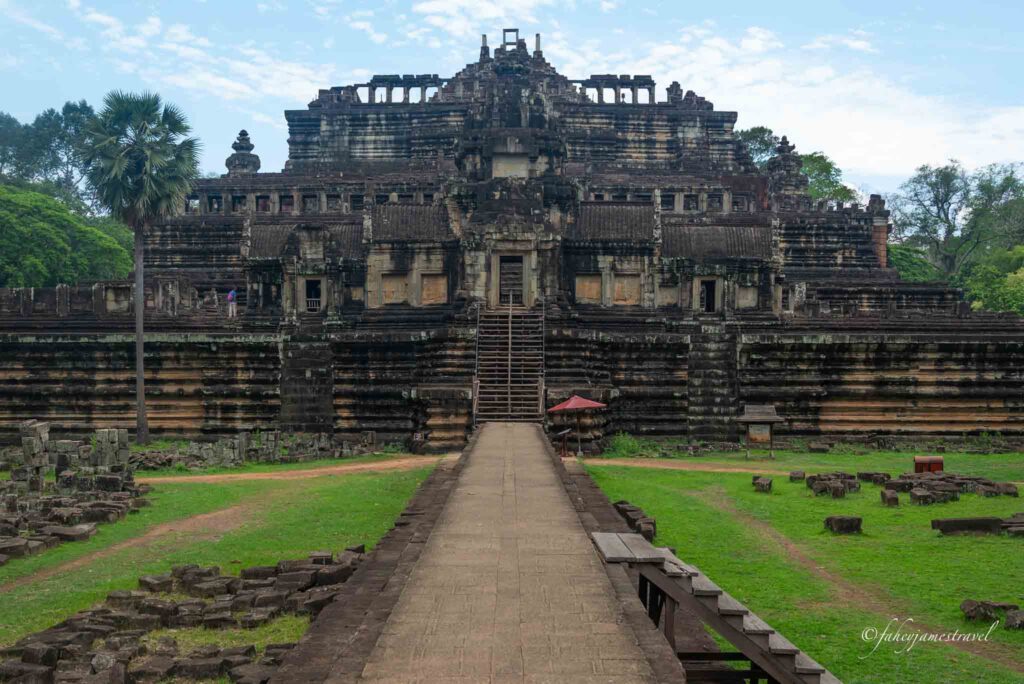
Temperatures range from 22 to 34 degrees Celsius, with lower humidity, making it an ideal time to explore the temples at Angkor.
I visited Cambodia in May, just as the hot, dry season was giving way to the rainy season. Honestly, I’d recommend it. It wasn’t too busy, even at Angkor Wat. March to May is Cambodia’s hottest time of year, so I experienced the heat first-hand.
It wasn’t as bad as I’d expected, but I’d choose November or February next time for cooler weather.
It was mostly hot and humid, with thunderstorms so loud they sounded like the sky was falling. Some days brought heavy rain, but overall, I had a great time with a mix of sunshine and clouds.
Whatever month you choose, plan your temple visits for early morning.
| Season | Months | Temperature | What to expect |
|---|---|---|---|
| Cool and dry | November to February | 21 to 33°C | The most comfortable weather and the busiest time to visit. Best for temples and island trips. |
| Hot and dry | March to May | 23 to 36°C, often hotter | Peak heat, with highs above 40°C possible in April. Rain starts arriving in May. |
| Wet | June to October | 25 to 34°C | Afternoon downpours, greener landscapes and fewer visitors. The heaviest rain falls in September and October. |
🏨 Find Out Where To Stay In Siem Reap 🇰🇭
How Many Days Do I Need In Cambodia
I’d recommend at least one week in Cambodia, or two if you have the luxury of time.

I spent nearly a month in Cambodia, and I still left places off my list.
If I could do it again, I would spend a little less time on Koh Rong Samloem. I loved my slow stay there, but I could have used some of those days to visit Tonle Sap, see Phare Circus or explore Koh Rong.
I would also have loved to visit Kampot and Battambang.
I spent three days exploring Angkor Wat and the surrounding temples, and I could have justified seven. I realise most people don’t have a full week for Angkor, and even three days can feel like a luxury. One day is enough to see Angkor Wat, but you’ll miss plenty of interesting spots.
If you can stretch to two weeks, do it. Here’s how I’d split your time.
| Trip length | What fits | Pass to buy |
|---|---|---|
| 3 to 4 days | Siem Reap and Angkor only | 1-day or 3-day |
| 1 week | Siem Reap and Phnom Penh | 3-day |
| 10 to 14 days | Siem Reap, Phnom Penh and Koh Rong Samloem | 3-day |
| 3 weeks or more | Add Kampot, Kep or Battambang | 3-day or 7-day |
Cambodia rewards slowing down.
🥗 Find Out Where To Eat In Siem Reap 🇰🇭
Where To Stay
Where you stay in Cambodia changes your trip more than you’d expect, especially on the islands.

I can only speak from experience about the places I stayed, but I’ll also list a couple of hotels in the cities worth considering if you have a little more to spend.
I stayed at Sovanphum Guesthouse and Restaurant.
The attentive staff helped me book a tour to the Killing Fields and S-21 prison. The restaurant served authentic Khmer dishes, and the guesthouse was within walking distance of the river.
I paid KHR 73,172 ($18.00/€15.90/£13.58) per night, including breakfast. It was good value, although the rooms were a little small.
Some Phnom Penh hotels to consider:
I stayed at Sara Resort on Koh Rong Samloem and loved it.
The staff were great, and the restaurant, with its pool right on the beach, was amazing. The bar was always fun, with people chatting and laughing. The rooms were small, but had a smart TV and comfortable beds.
I paid KHR 180,609 ($44.43/€39.26/£33.53) per night.
Other hotels to think about include:
This hotel had a great pool, huge, comfortable teak rooms and a cool glass restaurant where I could eat very well. It was a short walk into the centre of Siem Reap, so getting to the night market and Pub Street was quick and safe.
I paid KHR 67,968 ($16.72/€14.77/£12.62) per night.
Some other Siem Reap hotels include:
Book ahead in the cooler dry season, as the best-value places fill up first.
Visas And Entry
You will probably need a visa for Cambodia.

Cambodia’s visa process is simple, as long as you use the official websites.
Normally, a tourist visa lasts 30 days.
US citizens should check their entry requirements, as these differ from those for travellers from the UK and Australia.
You can get a visa on arrival, but I advise against it.
I got a visa on arrival when coming from Vietnam at the Mộc Bài/Bavet border crossing. It was chaotic: an official attempted to get a bribe from me, and they were very rude. Bring passport copies and passport photos, and keep them in your wallet as a backup. I always did this in Asia in case plans changed and things happened quickly.
It’s probably easier and safer to apply online. Get your Cambodia eVisa here. Processing takes three days, and it costs KHR 121,953 ($30.00/€26.51/£22.64).
Make sure you use the official site, not a fake site or a company offering to do it for you. You can easily do it yourself.
You also need to complete the Cambodia e-Arrival card within seven days before arrival. You can do this online for free.
Costs And Money In Cambodia
Cambodia was more expensive than I expected after travelling in Vietnam and Thailand, but it is manageable if you know where your money goes.

Prices in this post are from 2023, so expect them to be a little higher today.
I paid for most things by card or in US dollars in the cities, and sometimes received small change in Cambodian riel. When I tried to exchange my leftover riel in Thailand, I didn’t have enough for the teller to exchange, so it went to waste. Spend it before you leave.
If someone gives you damaged US dollar notes, don’t accept them.
They won’t be accepted, and you could be left with cash you can’t spend until you’re back in the US. Some hotels accept cash, while others only accept cards. Your best bet is to carry some cash too.
I typically spent KHR 135,503 ($33.33/€29.45/£25.15) daily.
Bring clean US dollar notes, keep some riel for small change, and you’ll be fine.
Don’t Go Abroad Without Comprehensive Travel Insurance. I Have Used And Trust Safety Wing
My Final Verdict On Cambodia
Cambodia has so many fun things to do, and it is easily worth visiting.
I would go back in an instant to see places I missed, like Kampot, Koh Rong, and Battambang. However, like so many people, my best memory is watching the sunrise at Angkor Wat. It was special to sit in a window frame in an ancient temple and watch the sun come up.
Cambodia can honestly suit any traveller. Couples, solo travellers, families, adventurers, hikers, and beach lovers. But don’t spend all your time in Phnom Penh; that’s my best advice.
If you’re going to Vietnam next, check out my guides covering most of the country.
Any questions? Just drop me a message.
Thanks for reading,
James
My Video on YT
FAQs
Is 4 Days Enough For Cambodia?
Yes, four days can make a great trip if you focus on one place, such as Siem Reap and Angkor Wat. It is much harder to include Phnom Penh and Koh Rong Samloem as well. I spent nearly a month travelling from Phnom Penh to Koh Rong Samloem and then Siem Reap, and four days would only cover a small part of that route properly. The drive between Siem Reap and Phnom Penh takes around five hours. With only four days, I would skip the Silk Island tour and the botanical garden in Siem Reap. I break down exactly how I would split your time in my How Many Days Do You Need in Cambodia section above.
Is Cambodia Really Worth Visiting?
Yes, Cambodia is absolutely worth visiting. Watching the sunrise at Angkor Wat was an outstanding experience, and one I had wanted for years. Cambodia is ideal for people who enjoy exploring ancient sites, including the temples at Angkor and museums in Siem Reap and Phnom Penh, such as S-21. It also suits anyone who wants slow beach days, like the ones I had on Koh Rong Samloem. I did not enjoy the heat in Phnom Penh during my morning runs, but I would go back to Cambodia tomorrow if you asked me. If you really struggle in the heat or hate long road journeys, though, plan your days carefully and start early.
Is $100 A Lot Of Money In Cambodia?
Yes, KHR 406,510 ($100.00/€88.36/£75.46) is a lot of money in Cambodia. It covered me for up to three days. You can use US dollars for most things or riel for smaller purchases, but I mostly used US dollars. Damaged notes will not be accepted. I learnt this the hard way on Koh Rong Samloem when a restaurant would not accept my money. Expect to pay a few dollars for a tuk-tuk ride in the capital, and between KHR 101,628 and KHR 182,930 ($25.00 to $45.00/€22.09 to €39.76/£18.87 to £33.96) per night for a mid-range hotel. The three-day Angkor pass costs KHR 252,036 ($62.00/€54.78/£46.79).
- Things To Do In Cambodia (2026): My Honest Guide After Visiting
- My Two Weeks In Cambodia Itinerary (From Someone Who Spent Nearly A Month There)
- How To Visit Angkor Wat In 2026
- Best Restaurants In Siem Reap: Where To Eat And What To Order
- Where To Stay In Siem Reap In 2026 (Neighbourhoods And Hotels)


