
10 BEST Things To Do In Phnom Penh
What Are The Best Things To Do In Phnom Penh?
Welcome to my guide to the incredible city of Phnom Penh! After spending 6 action-packed days exploring Cambodia’s busy capital, I’m excited to share the 10 absolute best things to do in Phnom Penh.
Having explored all the main attractions, from the magnificent Silk Island to the sobering Killing Fields, I can confidently say that Phnom Penh offers a nice blend of history, culture, and modern city life that shouldn’t be missed on any Cambodia itinerary.
While cities like Siem Reap with Angkor Wat and the paradise island of Koh Rong Samloem often steal the spotlight, Phnom Penh holds its own with sombre historical sites, amazing food scenes, and warm local hospitality that will capture your heart.
I promise to walk you through the most rewarding experiences in Phnom Penh, complete with practical tips and insights from my visit to help you make the most of your time in Cambodia’s capital city.
Sounds good to you? Let’s begin.
Disclosure: Some of the links on this page are affiliate links, which means that if you make a booking through them, I may earn a commission at no additional cost to you. See my Privacy Policy.
Phnom Penh Travel Vlog: The Killing Fields

Visit The Magnificent Royal Palace
The Royal Palace is one of the most iconic landmarks in Phnom Penh and a must-visit attraction for anybody who comes for a visit.

When I walked passed this Palace every day, monks would pass me in the street who often greeted me warmly. Others would simply sit in front of the Palace and chat with friends and family.
The Royal Palace complex has several impressive parts, including the Silver Pagoda.
Inside, you will find over 5,000 silver tiles, which is hard to believe.
Additionally, you’ll find plenty of valuable Buddha statues and artefacts.
Also located inside the Royal Palace are the Throne Hall, Moonlight Pavilion, Napoleon Pavilion, Phochani Pavilion, and Khemarin Palace, to name a few.

The Royal Palace has a blend of traditional Khmer design and French colonial influences, which is clear to see the moment we start walking towards it in the street.
To be honest, it has some beautiful details, bright colours, and impressive decorations, all of which make it a magnificent sight to visit.
Let’s talk about the opening hours for a moment.
The palace is open to the public from 8:00 AM to 11:00 AM and from 2:00 PM to 5:00 PM. The entrance fee for foreigners is $10.00, and you have to pay more if you want to take photographs or visit specific areas within the complex.
The staff were strict on clothing, and you won’t be allowed in without the right gear.
Some people were refused entry when we were at the ticket office because they didn’t stick to the rules.
This is one of the main attractions in Phnom Penh. I urge you to set aside plenty of time to fully appreciate the Royal Palace.
Check out the must-see attractions in Cambodia to plan your trip.
The National Museum Of Cambodia
This museum has one of the most beautiful exteriors I have seen in Southeast Asia, and that says a lot!
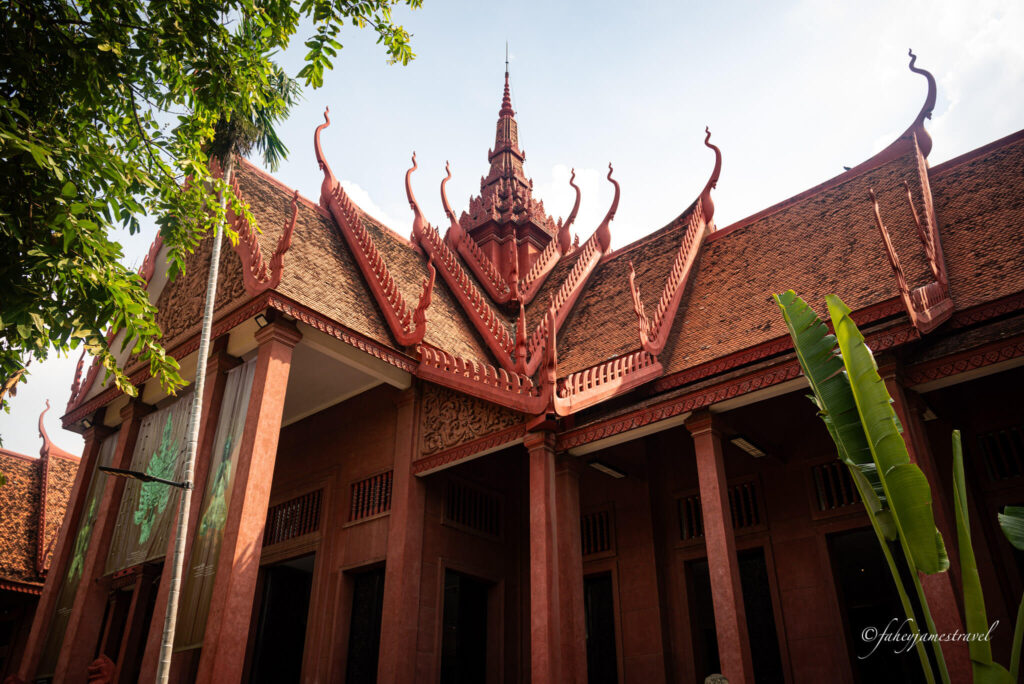
Honestly, this was one of my highlights. The National Museum of Cambodia gave me a deep dive and crash course in Cambodian History in a vivid and engaging way.
I was blown away by the 14,000-plus items found inside. The Khmer EMpire covered large swaths of land in todays Thailand, vietnam and cambodia.
There are plenty of amazing Vishnu statues found inside the museum grounds, all of which have a story and information panel about them.
Then there is the exterior of the museum. The red terracotta style was truly inspiring. I almost felt intimidated when standing underneath the tall wooden structure.
When we visited the museum, there were two monks wandering in the central courtyard. They were in a training period, and we were able to speak briefly with them and take a photo together, which was a genuinely warm encounter.
As you would expect from a Buddhist monk, they were calm and soft-spoken and it was a beautiful interaction.

Additionally, make sure you give enough time to go around and appreciate all there is inside.
When I visited, I must admit I lacked a lot of information about Cambodia’s past. Once I exited, I felt totally more informed about the tragic and powerful history of Cambodia.

The National Museum of Cambodia in Phnom Penh is open from 8:00 AM to 5:00 PM. The entrance fee for foreigners is $10.00.
You can enter the National Museum of Cambodia between 08.00 AM to 05.00 PM, and for all foreigners it costs $10.00 per person.
I found this to be expensive compared to other museums in Southeast Asia, but I was happy to experience such an educational museum.
Phnom Penh Historical City Tour
Taking a tuk-tuk tour of Phnom Penh is a great way to learn about Cambodia’s past.

While walking around the Royal Palace we met a guy in a tuk-tuk who gave us a quote and listed all the sites we would see.
Pagodas and a silk farm were included, and it sounded like a good deal and itinerary.
Please note – you can negotiate with any tuk-tuk driver to get the best price for something like this.
But remember, the first price is never the price. However, make sure the price is fair for everyone.
My experience in Phnom Penh and Cambodia more broadly is that I found that negotiating with people in Cambodia in a friendly and fun manner will lead to the best outcome for you and the driver.

Our driver brought us to the ferry. We made our way across the Mekong River to Silk Island, where we got to experience how clothing was made.
We even bought a few pieces, which, let’s just say, we were enthusiastically encouraged to purchase from the staff.
Still, it was a great experience to see how this type of textile is produced daily in Cambodia.
The Golden Temple
The Golden Temple was beautiful, inspiring, and interesting.

While the exterior of the temple is golden, I was taken aback by the drastic change of colour on the inside.
When we visited, it was hard to phantom that there were so many tourists around. It was so impressive. Apart from a couple of locals, it was just us and our driver.
The temple was in mint condition. Every inch of the construction was maintained well.
The level of detail I could see close up in the walls and prangs left me speechless.

While inside, we did see a couple of monks around the side of the temple, but we stayed away this time as it looked like they were doing their routines.
In Phnom Penh, we often found the monks to be open to conversation. However, not on this occasion.
That isn’t a complaint but respect the monks who are based at these temples are remember you are a visitor.

As you can see from the photos, there is plenty of colour to be found on the inside.
If I were a first-time visitor to Phnom Penh, I would make sure to visit the Golden Temple.
Visit A Local Market
Phnom Penh is famous for its local markets and street food options.

Exploring these markets can be a fun experience, offering a taste of the city’s real flavours and hectic atmosphere.
When we visited, it was a great atmosphere moving through the markets, chatting with merchants and feeling ingrained into life in Phnom Penh.
One of the most popular markets is the Central Market.
You can find loads of goods, including fresh food, clothing, jewellery, and souvenirs.
All these types of things you would expect in local markets in Southeast Asia. The market also features a food section where you can try various local dishes.
Make sure to try the popular street food options at the Central Market.
These include num pang (Cambodian-style baguette sandwich), nom banh chok (Khmer noodles with fish-based gravy), fried insects, and fresh tropical fruits.
My personal favourites were Lok Lak and Amok. Truly amazing Cambodian food that you need to try once.
Maybe skip the insects if you like. I sure did.
Another interesting market is the Russian Market (officially known as Toul Tom Poung Market).
This market is known for its wide range of products like clothes, accessories to handicrafts, artwork and much more.
Tuol Sleng Genocide Museum
The Tuol Sleng Genocide Museum is another place that is simply unmissable.

Visiting the Tuol Sleng Genocide Museum was a dark insight into Cambodia’s tragic past. But it is important to learn about what happened.
Honestly, it is a dark and depressing experience.
However, it was a pivotal moment in Cambodia’s history, and not visiting this museum would be a mistake.
Interestingly, the museum was built on the site of the former Security Prison 21 (S-21). S-21 was the notorious Khmer Rouge prison during the government’s rule from 1975 to 1979.
Within this time, tragedy befell the country.

The prison was actually a high school in the past. It was known as Tuol Svay Prey.
However, its function drastically changed under Pol Pot and his accomplices. Torture, interrogation and atrocities were the norm inside.
Between the years 1976 and 1979, it is through over 20,000 people were forced to stay here.
The museum was established to preserve the memory of the countless victims who suffered and lost their lives within its walls.
Today, the idea of the museum is to keep what happened in people’s memories and for the victims who were treated so inhumanely.

When we visited, it got quiet very quickly. Not many people spoke once inside. I could see the numbers written on the walls, which really hit home.
For me, the most difficult part was looking at the photographs. Victims had their stories and circumstances archived. The items and weapons used to belittle and murder were on display for all to see.
The rooms were small. I could imagine animals living here, not humans.
When we walked around the courtyard, it was eerie and quiet.
You can get a tour guide. Or if you prefer to be alone, you can rent an audio guide for $5.00, which we did.
For me. It was worth it to get an in-depth explanation of what you see in the museum.

A man named Chum Key survived the genocide and wrote a book about his experience.
When we visited, we found him sitting near the museum exit, where you can donate or buy a copy of his book and take a picture with him if you want to show some support.
We were told that we would be drained at the end of the visit, which we duly were.
However, the museum wants tourists to be a messengers of peace, to prevent something like that from happening again.

To be honest, I was not mentally prepared for this museum. The stories made my stomach turn.
When we visited, it rained most of the time. I would suggest bringing a light rain jacket if you travel in the rainy season. You can rent an umbrella inside for a small extra fee.
There is some good shelter from the rain, but the courtyard is worth exploring too, so be prepared to get wet.

The entrance fee for foreigners to the Tuol Sleng Genocide Museum is $5.00 and it is open from 8:00 AM to 5:00 PM every day of the week.
Visit The Killing Fields
One of the most common sites visited in Phnom Penh is the Choeung EK Genocidal Centre, AKA, the Killing Fields.

Similar to the Tuol Sleng Genocide Museum, it shows how terrible humans can be to each other at different times in history.
Usually, the Killing Fields and Tuol Sleng Genocide Museum are visited together in the same day tour, which we did.
I did not know then, but the killing fields are actually several different locations in Cambodia. Officials say up to 1.7 million people were murdered by the Khmer Rouge from 1975-1979.
Imagine this. Any person who was considered to be on the opposing side of Pol Pot became a victim. Educators, doctors or religious people. Nobody was spared.
A Yale University study sadly discovered over 20,000 sites where many were burired.
In the end, it took the Vietnamese Army to invade Cambodia and rid it of Pol Pot and his allies.

While inside, we walked around and read the signage, which talked us through each part of the field.
I did learn about what unfolded in the area where I was standing during this horrid time in Cambodia.
I could see the chemical storage units as well as the rags of victims and the mass graves in the ground.
When we visited, I found it very hard to process all of the information.

One of the more terrifying parts of the Choeung EK Genocidal Centre was the memorial tower. It was inside the skulls of many genocide victims.
It was here that we were asked to respect all the victims who were murdered under the Pol Pot Regime.

We paid $20.00 for the tour, but entrance fees and a tour guide were not included, just the tuk-tuk driver who waited for us outside.
This was one of the most memorable and striking places I visited in all of Southeast Asia for all the wrong reasons.
Mekong River Boat Trip
What a beautiful way to see Phnom Penh, especially if you go at night time.

We paid $5.00 for a one-hour boat tour and it included one beer/bottle of water.
When we visited, there were dozens of men lining the Tonle Sap River looking for tourists to take along the water. One fellow enticed us happily onto his boat.
This was at Sisowath Riverside Park, where many other people enjoyed singing aloud and having a beer while enjoying the city lights of Phnom Penh.
You will see just how busy the river is here. Other party boats and fishermen travel up and down throughout the day highlighting the river’s importance to the local people.
This was a magical experience and one thing we continue to do whenever we visit a new city.
You can board the boat and set off on a leisurely journey along the river.
One of the highlights of the boat trip is the opportunity to enjoy the stunning city lights of Phnom Penh at night. As we sailed along the river, we relaxed, listened to music and even sang with fellow passengers.
I found it to be a fun experience, which allowed us to see the city from a different perspective.

Visit Wat Phnom Daun Penh
Now this is an awesome and unique temple you have to visit!

Located just beside the Tonle Sap River and beside Phnom Penh’s giant clock is Wat Phnom Daun Penh.
This temple is an immensely significant historical and cultural site in the city and holds immense importance as it is firmly believed to be the birthplace of the city of Phnom Penh.
When I was in Phnom Penh, it soon became clear how significant this place was to the people of the city. The story goes that it is the birthplace of Phnom Penh and additionally one of the best places to visit!
So the story goes, back in the 14th century, there was a woman named Daun Penh.
Interestingly, she discovered four bronze Buddha statues and a historic relic inside a floating tree on the river.

She became interested in what she could see.
Thereafter, she brought them ashore and decided to build a little hill (Phnom) to be the home of her new finds.
And guess what? That hill ended up becoming Wat Phnom Daun Penh!
So, what you have here is that the temple is dedicated to Lady Daun Penh. Today, it has become a popular destination for both locals and tourists.
It is a symbol of spirituality and even serves as a place of worship for the Buddhist community in Phnom Penh.

When I was there, I was able to climb the staircase to the top of the hill, meeting many strangers along the way and having warm chats with them about Cambodia, which was nice to do.
The views were very cool too!
You will also find beautiful gardens and statues showing Buddhist figures on the way up.

Once at the top, you can explore the temple complex and the beautiful architecture.
We were able to appreciate the colour and the Buddhist religion once again.
My favourite thing about Wat Duan is that you can escape the hectic city without leaving it.

Wrapped away in a small compartment of green is where you will find the temple. Once I was hidden away from the noise, I was able to reflect, meditate, and appreciate my setting. Terrific!
We also met three young kids who were very happy to chat with us and be filmed for my travel vlog.

If you’re interested in exploring Phnom Penh’s historical sites and experiencing its culture, a visit to Wat Phnom Daun Penh is highly recommended.
Walk The Riverside Promenade
Take a stroll along the riverside promenade in Phnom Penh and soak up the lively atmosphere along the Tonle Sap River.

As we walked along the river, we met friendly locals and fellow tourists, who looked to be having a great time.
We also came across a couple of outdoor gyms where local elderly people work out and stay active.
No matter what your age is, feel free to join in and experience the Phnom Penh energetic community. I felt part of the city for a short time!
I recommend you chat with the locals and get to know more about them.

Also, don’t miss the chance to catch live sports events on the massive outdoor TV screens.
Whether it’s a football match or another sport, you can join in the excitement and cheer with the passionate crowd.
The festive atmosphere added an extra spark to my stay in Phnom Penh and now I see that Cambodians are huge sports fans!

For me, a long walk or jog along the riverside promenade in Phnom Penh is a really nice experience and a way to meet people.
Also, the scenic views of the Tonle Sap River and the chance to be part of the vibe and community felt good.
Where To Stay In Phnom Penh
We stayed in the Sovanphum Riverside Hotel and it was a very nice hotel, although the room was a little small.
I was happy to overlook that because the restaurant was fabulous with real quality Cambodian food on offer.

Another great option is the 4-star HM Grand Central Hotel, which has an outdoor swimming pool and an 8.4 rating on Booking.com.
Or you can look at G Mekong Hotel Phom Penh with a pool, fitness centre and spa.

For those on a smaller budget, you could look at Hotel Zing Phnom Penh, which has a restaurant, breakfast and airport shuttle.
Is Phnom Penh Worth A Visit?
Yes, Phnom Penh is worth visiting!
The city has so much to offer. I was blown away by the museums and beautiful pagodas. The food is incredible. The people are warm, and you can experience plenty of Cambodian culture and learn about the tragic history.
The Tuol Sleng Genocide Museum and the Killing Fields are powerful but important things to do in Phnom Penh.
The Royal Palace and the National Museum of Cambodia are also must-visit sites.
Plus, Phnom Penh has a few really nice markets which you can explore on foot and purchase whatever you may need, from food to souvenirs.
Seriously, Phnom Penh offers so many interesting things to do that I don’t know why it’s not more popular as a tourist destination in Southeast Asia.
PS. If you are travelling to Cambodia for the first time, check out this itinerary.
Best Time To Visit Phnom Penh
The best time to visit Phnom Penh is during the dry season (November to February).
The weather is nice and cool during this time, perfect for walking around and seeing the sights. Just remember that more tourists visit during these months.
March to May is very hot, but you’ll find fewer tourists and cheaper hotels.
The rainy season runs from June to October. You’ll need an umbrella, but the city looks beautiful and green, with fewer crowds.
We visited in May, and while it was very hot at times, we had some heavy showers, which were welcome. But overall, we never felt the desperate need to get out of the heat, thankfully.
Enjoyed this post? Check out this article, 10 Cambodia travel tips you need to know before you go to plan your trip effectively.
Thanks for reading,
James
FAQs
Is There Anything To Do In Phnom Penh?
Yes, Phnom Penh has plenty of fun things to do. Some of the best activities include visiting the Royal Palace, taking a Silk Island tour, and learning about history at the tragic S21 Prison and Killing Fields. There’s also a nice nightlife scene and delicious food to try. You can walk along the beautiful Mekong River or visit my personal favorite, the National Museum of Cambodia.
How Many Days Should I Spend In Phnom Penh?
I suggest staying at least 3 days in Phnom Penh, though 5 days is even better. Why? You’ll want to visit all the main attractions and do some day tours. These activities can take up a full day or half day each, so time runs out quickly. I recommend a minimum of three days to see the main attractions, with extra time to explore other parts of the city if possible. Some of the best things to do in Phnom Penh take a full day, like the Killing Fields and S21 Prison.
Is Phnom Penh A Party City?
Phnom Penh has been ranked as having a great nightlife scene. However, when I visited, it felt more laid-back than Bangkok or Siem Reap. There are fun nightclubs to party at, but you can also do karaoke with strangers if you want a more relaxed vibe. One of the best things to do at night is to walk along the river promenade and soak in the atmosphere.
- Bai Dinh Pagoda Travel Guide: Tickets, Tips, and Honest Review
- Hang Múa Cave And Viewpoint: Is It Worth 500 Steps?
- Bich Dong Pagoda – All You Need To Know
- Hoa Lu Ancient Capital: Vietnam’s Best-Kept Secret
- Where To Stay In Ninh Binh: All You Need To Know




Cambodia and Vietnam have been on my list for far too long, and this post reminds me why I am drawn to the area. Phnom Penh would be a highlight with the stunning architecture and brilliant sites. I would challenge myself to taste so many new foods (not the insects, I’m not that adventurous!).
The Genocide Museum and Killing Fields would be necessary and worthwhile stops. The dark crimes of Pol Pot are horrifying and no doubt profoundly disturbing, but we need to recognize and acknowledge of the evils that humans are capable.
I love visiting capital cities, especially ones that I don’t hear as much of in the travel space. I know some really horrific things went down in Cambodia’s past, so I would really appreciate the opportunity to visit the Genocide Museum in person because I know it would be moving in a very powerful way. On a lighter note, I don’t actually think I’ve tried Cambodian food before, so a market tour would be great to see the raw ingredients, then maybe a food tour to see (and taste!) it all put together.
Starting off at the national museum seems like a good way to get a feel for Cambodia, a country I’ve wanted to visit but haven’t yet made it to. I’ve heard of the killing fields, and while it is a dark part of Cambodia’s past it does sound worth visiting for those interested in history, same goes for the genocide museum. Although balancing these activities with some fun ones would be necessary. I love the idea of the tuk tuk tour and the river boat cruise, two unique ways to get around
I’ve had Cambodia and Vietnam on my wish list for a long time and friends who’ve visited always come back with positive reviews and great photos.
The history of the country is fascinating – I remember watching the news as a child when Pol Pot was overthrown and being horrified. As tough as it would be to visit the Genocide Museum and Killing Fields it’s important to acknowledge the country’s dark past.
Your food photos look delicious but I’d leave the insects to my partner who, I’ve no doubt, would give them a try!
I appreciate you mentioning that Phnom Penh is quieter and more laid back than Sieam Reap or Bangkok, which I prefer. I am intrigued what you have bought from Silk Island? I have watched a few documentaries on silk production in Cambodia, mostly the lost art of Lotus silk and how long the process of winning the fibre is. I agree with my fellow commentators, the killing fields are a must when visiting Cambodia. The various temples and the boat tours would be high on my list, too. Thanks for always including additional logistics such as booking a driver or a tuk tuk in advance.
Carolin | Solo Travel Story
The killing fields sound awful but such an important visit-I believe the only way to stop these awful things happening again is to learn from the past, and part of that is us tourists being a bit uncomfortable for a few hours whilst we learn what the locals want to tell us. I hugely respect that the Royal Palace didn’t let people in who didn’t follow the rules, too-just be respectful and do as you’re asked to.