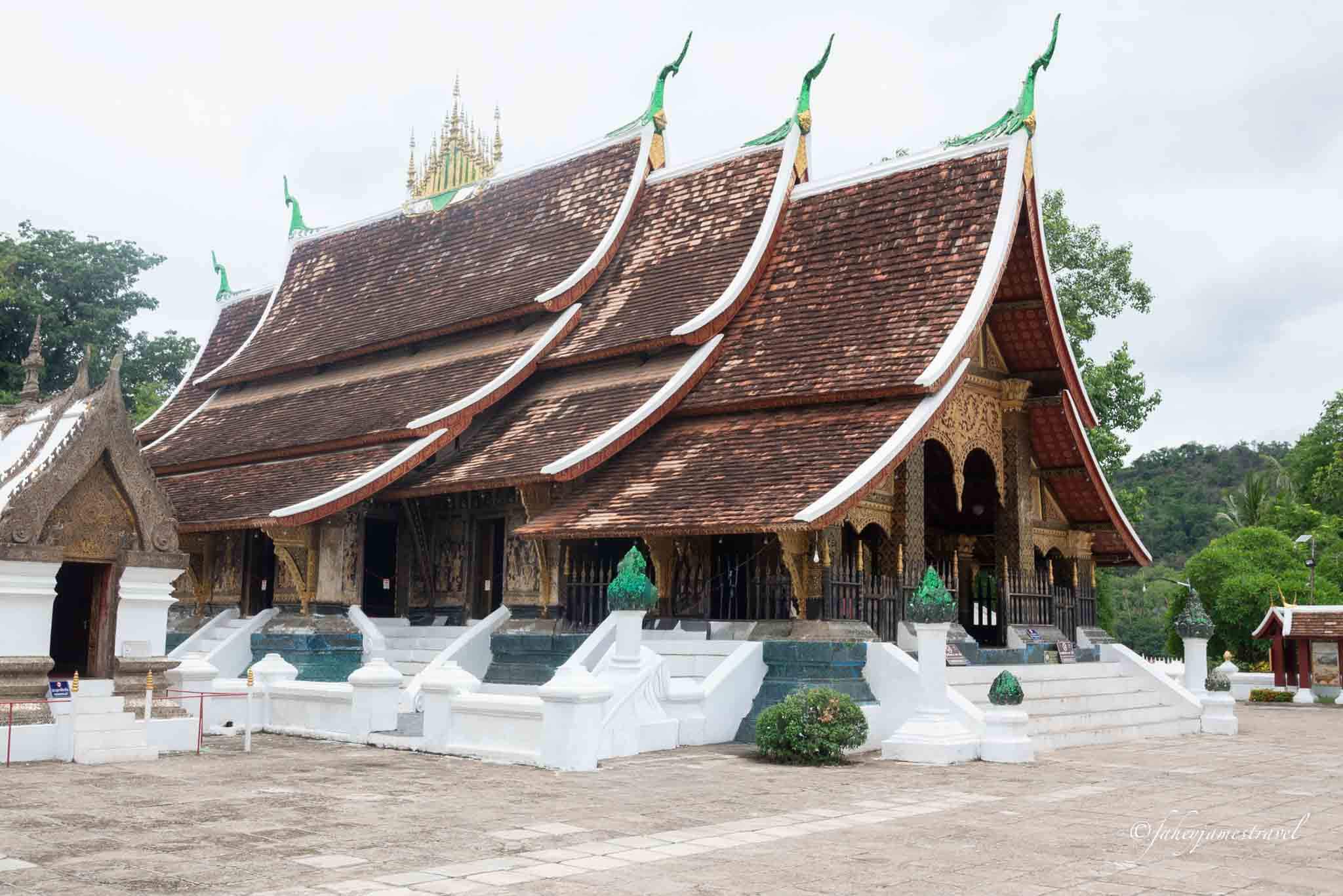
The Best Temples in Luang Prabang (8 I’d Actually Recommend)
Explore The Stunning Temples In Luang Prabang
I spent 10 days in Luang Prabang, wandering between temples, eating my body weight in Lao food, and cycling out to waterfalls when I needed a break from monastery fatigue. So I’ve got a decent feel for which temples earn their spot on your itinerary and which ones you can happily skip.
I’ll be honest, temple fatigue is real. Thirty-plus temples sound exciting until you’re standing in front of your eighth gilded roof of the day, wondering if you’ve already seen this one. Add in entrance fees that creep up faster than you’d expect, and a few temples that are genuinely a trek to reach, and it’s easy to see why people get overwhelmed before they’ve even landed.
Here’s where I’ll admit something that surprised me. I didn’t expect a single building to stop me in my tracks, but Haw Pha Bang did exactly that. The gold exterior catches the light in a way photos never quite capture, and I remember standing there longer than I’d planned, just looking at it. That’s the moment that convinced me that not every temple in this town is interchangeable.
Whether you’re travelling solo and want to build a loose temple-hopping route, or you’re exploring as a couple and want to know where to actually spend your time and money, this is for you.
Think of it less as a checklist and more like a friend telling you where to point your energy.
Disclosure: Some of the links on this page are affiliate links, which means that if you make a booking through them, I may earn a commission at no additional cost to you. See my Privacy Policy.

🇱🇦 Luang Prabang Quick Guide 🇱🇦
- When To Visit:
Best Months To Visit Luang Prabang (Dry season Nov–Feb is ideal). Weather & Festivals (like Lao New Year / Pi Mai) - Getting To Luang Prabang: Flights To Luang Prabang. Overnight Buses & Minivans. Private Transfers / Car Rentals
- Things To Do In Luang Prabang
Alms Giving Ceremony, Pak Ou Caves, KuangSi Waterfalls, Sunset Cruise - Get Trusted Travel Insurance – I Use Safety Wing
Temple Etiquette In Luang Prabang
When visiting temples in Luang Prabang, you need to show respect as a visitor.
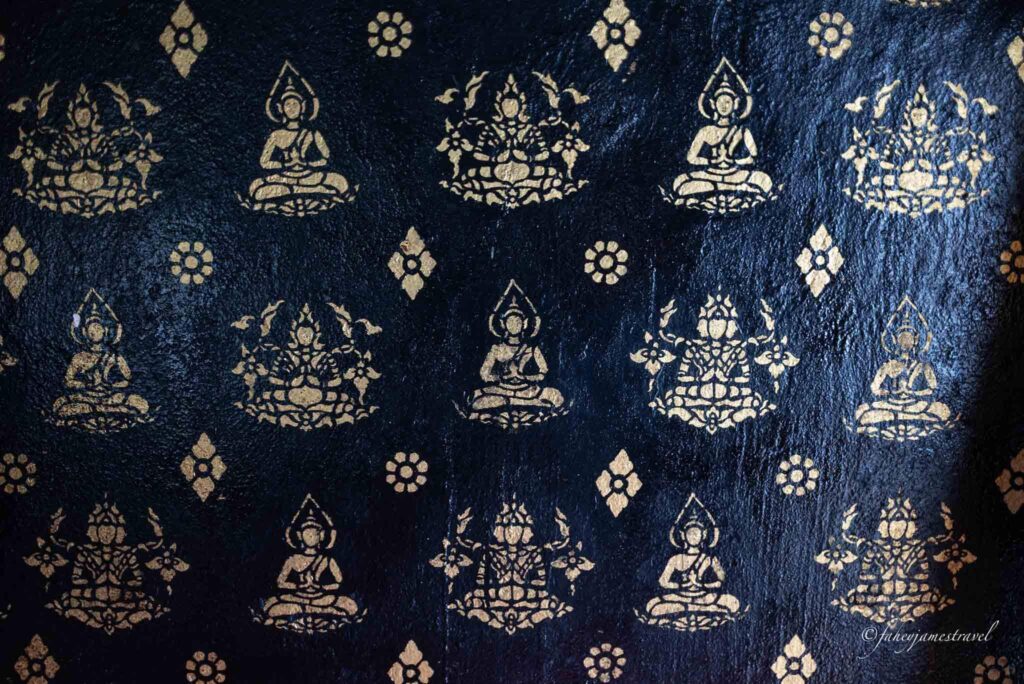
Cover your shoulders and knees, as is common across much of Southeast Asia.
Take off your shoes before entering, keep your distance from monks, and do not touch them. Bring cash so you can pay any small fees, as places often do not accept cards. Be respectful when taking photos, and do not be loud.
Any time I crossed paths with a monk in Luang Prabang, they smiled or stayed neutral, and we both did our own thing. Whenever I was respectful, they returned the behaviour.
So show manners and follow the basic rules, and you will be fine.
Vat Wisunarat
Vat Visounnalath was one of the first temples we explored in Luang Prabang.
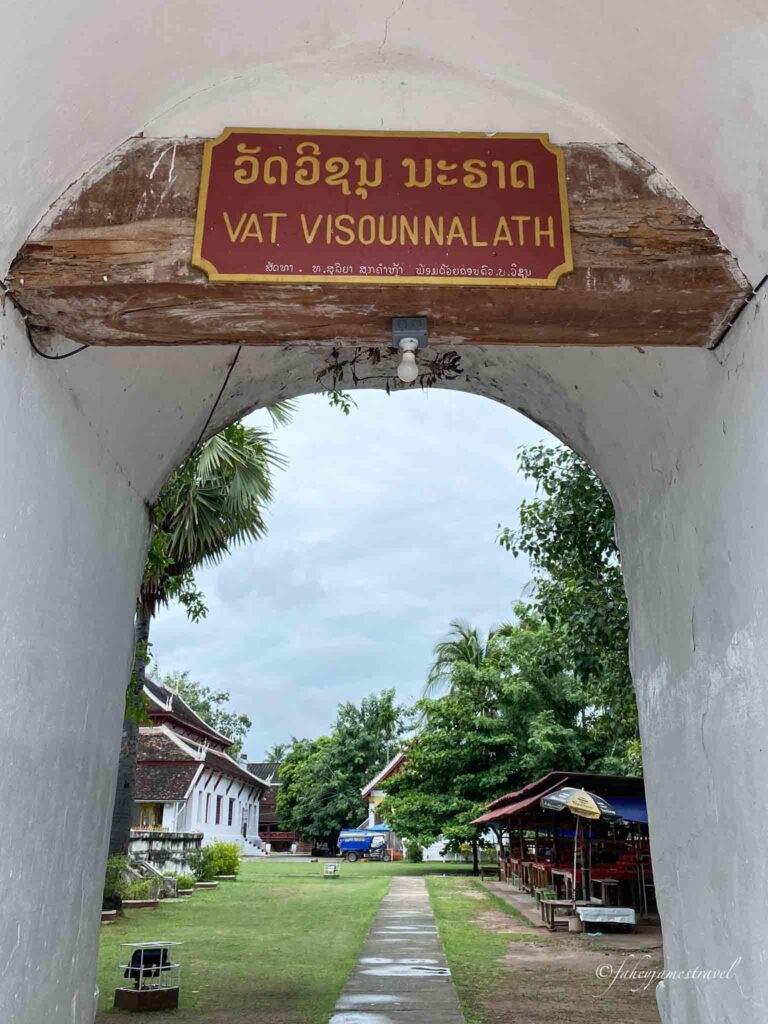
It gave us a welcoming taste of what was to come in the following days,
Vat Wisunarat was built in 1513 by King Wisunarat and is one of the oldest temples in Luang Prabang. I remember walking up the steps through the archway and onto what is now a chalked-out playground for kids to play games right in front of the vat.
Trees cover the vat from the streets, so you can see it much clearer once inside. Behind it, across the yard, is Wat Makmo, which lacks any sign of upkeep on the exterior.

The temple is known for its unique blend of Lao architectural styles.
They can be seen in its carvings and detailed murals. I stood in the centre of the yard for a few moments, gazing up at the nine gilded lotus-bud finials, imagining how many monks must have passed by it over the years since the 16th century.
The vat does have lots of weather damage and badly needs a paint job, but without the clean finish, it feels far older.
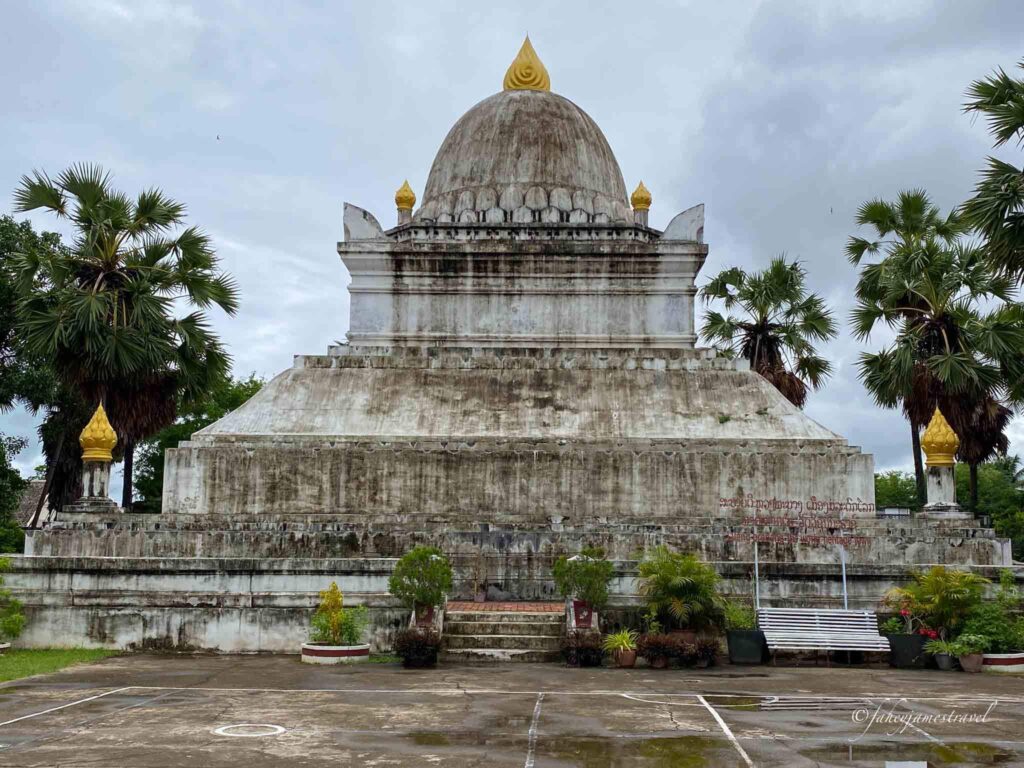
The temple’s main attraction is the That Pathoume, also known as the Watermelon Stupa. Inside, you can find lots of old gilded Buddha statues.
Best to go early in the morning to miss any crowd. When I went, it was around 10.00 AM, and there were no other visitors.
The original doors from the 16th century are still there today.
- Opening Times: 08.00 AM – 5.00 PM
- Suggested Duration: 1 hour
- Cost: Free
- Address: V4PQ+VHV, Luang Prabang, Laos
Read About The Laos Slow Boat Trip
Vat Sensoukharam
Vat Sensoukharam is a beautiful temple with golden leaf decorations.
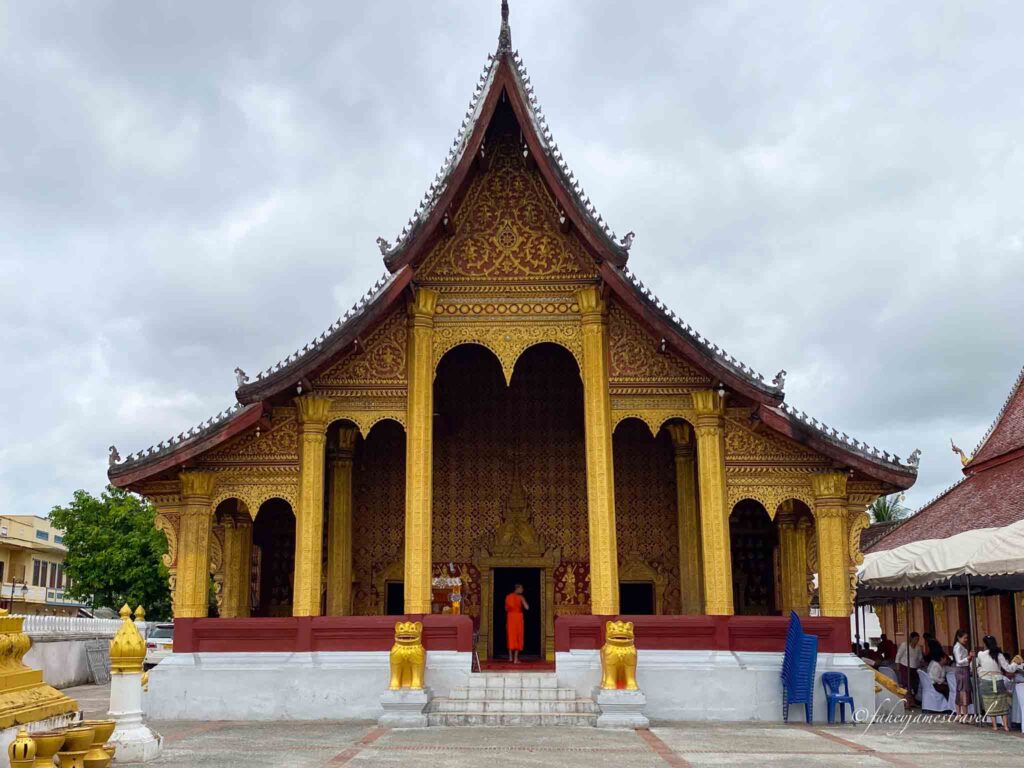
Its name means “100,000 treasures”, and there are different legends about how it got this name.
When I visited it was struck by the number of buildings. I counted 8 points of interest inside the grounds. The beautiful red and golden colours are used a lot here, and inside the main vat, you will see a large golden Buddha with amazing red and gold colours covering the pillars.
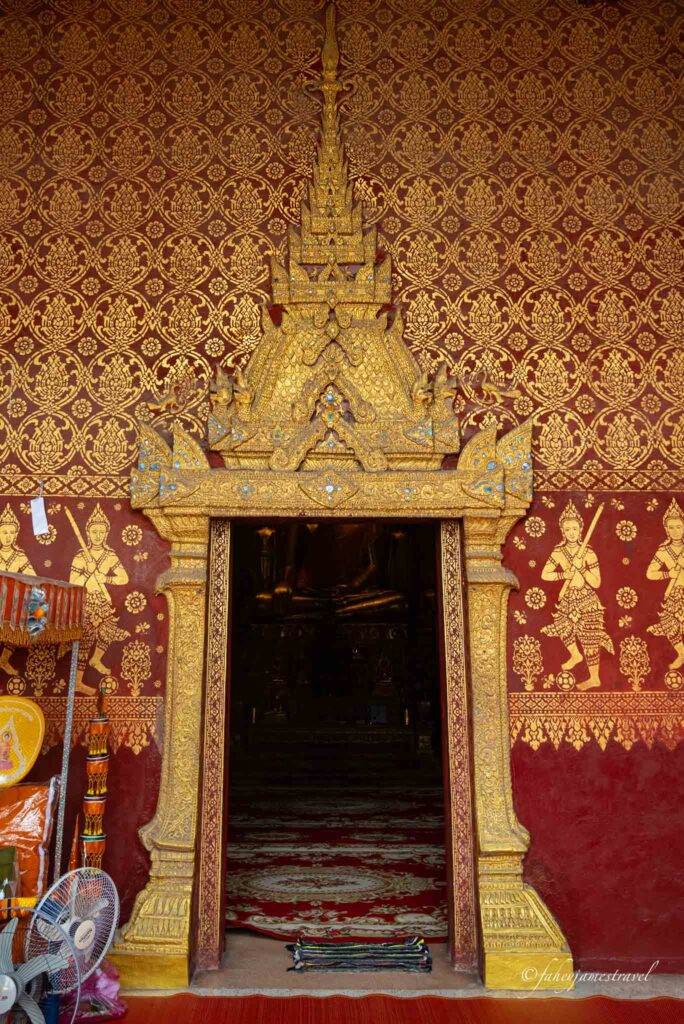
One legend says that the temple was built with 100,000 stones from the nearby Mekong River. In contrast, others claim that it was named after the 100,000 Laotian KIPs that were needed in 1718 to build the temple.
There were only a few people roaming around when I visited, which made it even more peaceful.
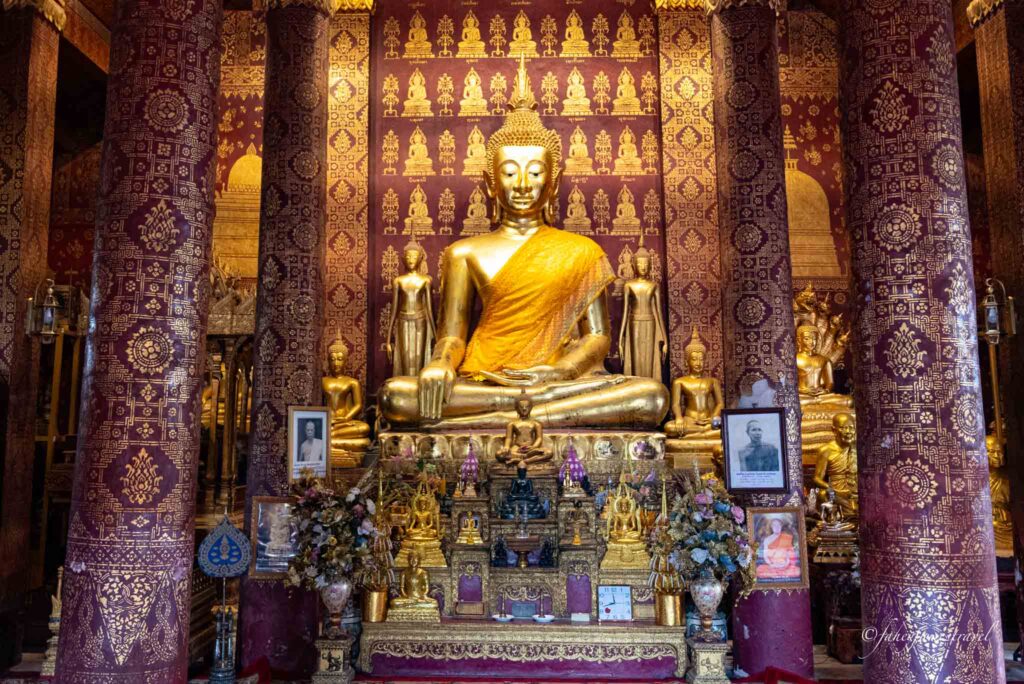
The temple is conveniently located in the old quarter of town along the main street (Sakkaline Road), between Vat Xieng Thong and Phousi Mountain, with stunning views of both the Nam Khan and Mekong rivers.
- Opening Times: 08.00 AM – 05.00 PM
- Suggested Duration: 30 minutes
- Cost: Free
- Address: V4WR+5M2, Luang Prabang, Laos
Find Out If Luang Prabang Is Worth Visiting
Vat Syrimoungkoun Xaiyaram
Vat Syrimoungkoun Xaiyaram is easy to identify because of two white lion statues outside the entrance, which will capture your attention immediately.
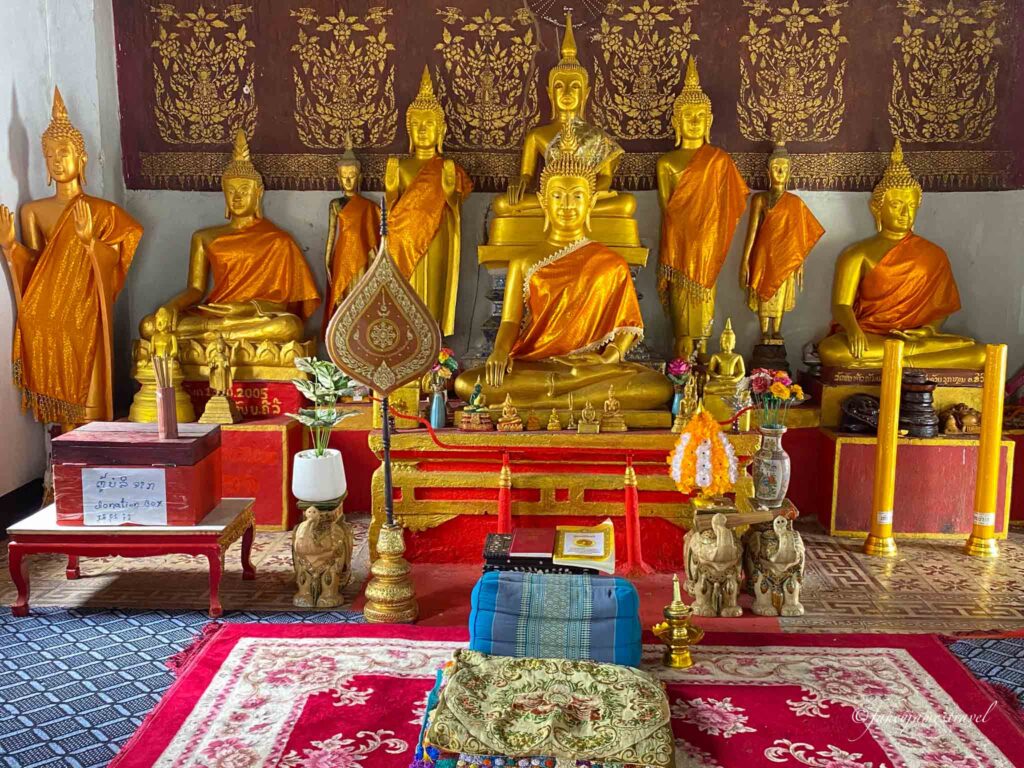
It was built in 1763 during the reign of Chao Jotika, and the ordination hall or sim is what makes this place special. Inside, I counted 9 golden Buddha statues, and the floor had carpet.
The temple complex may have a smaller building for worship, but it has a large courtyard where you can often see young novice monks studying in the shade of frangipani trees.
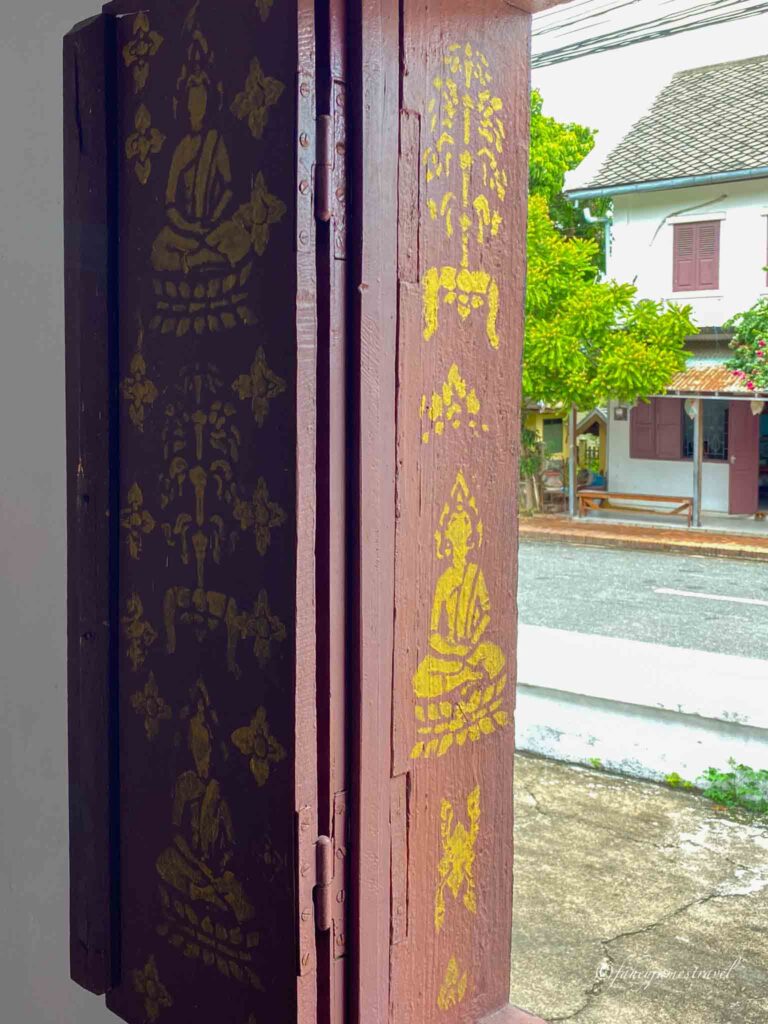
I saw a large bell in the centre of the complex, and on the windowsill, you could see golden paintings of Buddha. This peaceful temple helped me to relax because it felt smaller and more hidden away than the other vats.
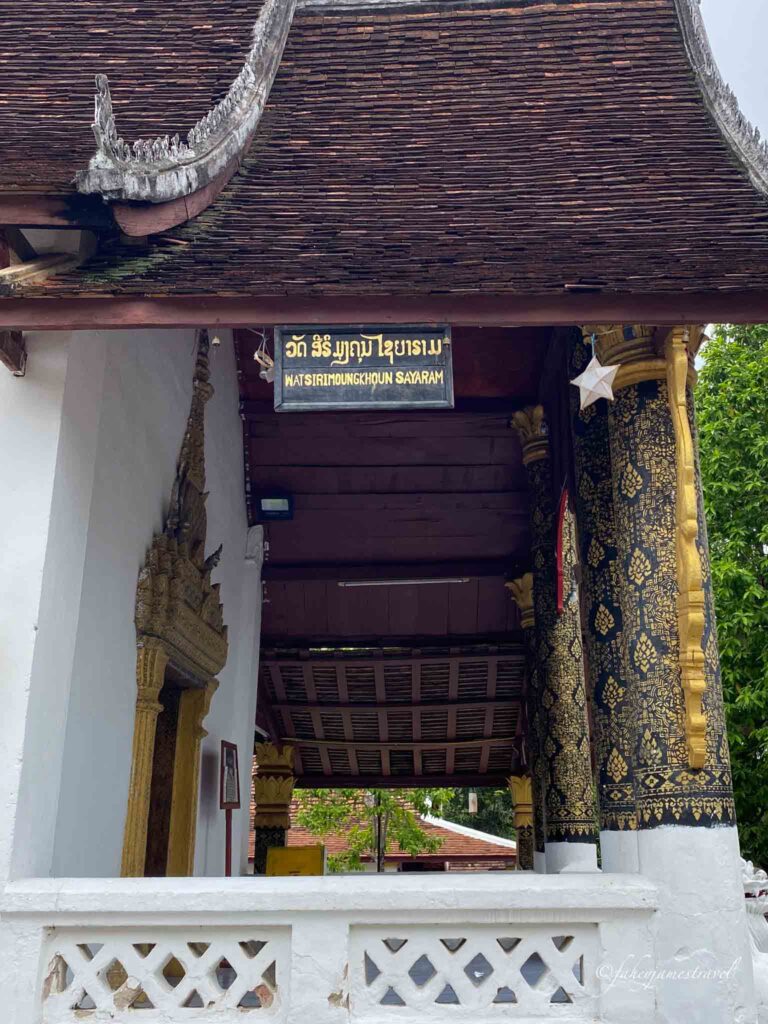
The monks who live in the kutis (living areas for the monks) will be roaming around the courtyard, and they are also found in other temples in Luang Prabang.
When I visited at midday, it was totally empty of other travellers except an odd monk passing through.
- Opening Times: 08.00 AM – 5.00 PM
- Suggested Duration: 30 minutes
- Cost: Free
- Address: V4WV+F33, Luang Prabang, Laos
Discover How To Get From Vang Vieng to Luang Prabang
Vat Sibounheuang
Vat Sibounheuang is one of Luang Prabang’s magnificent temples.
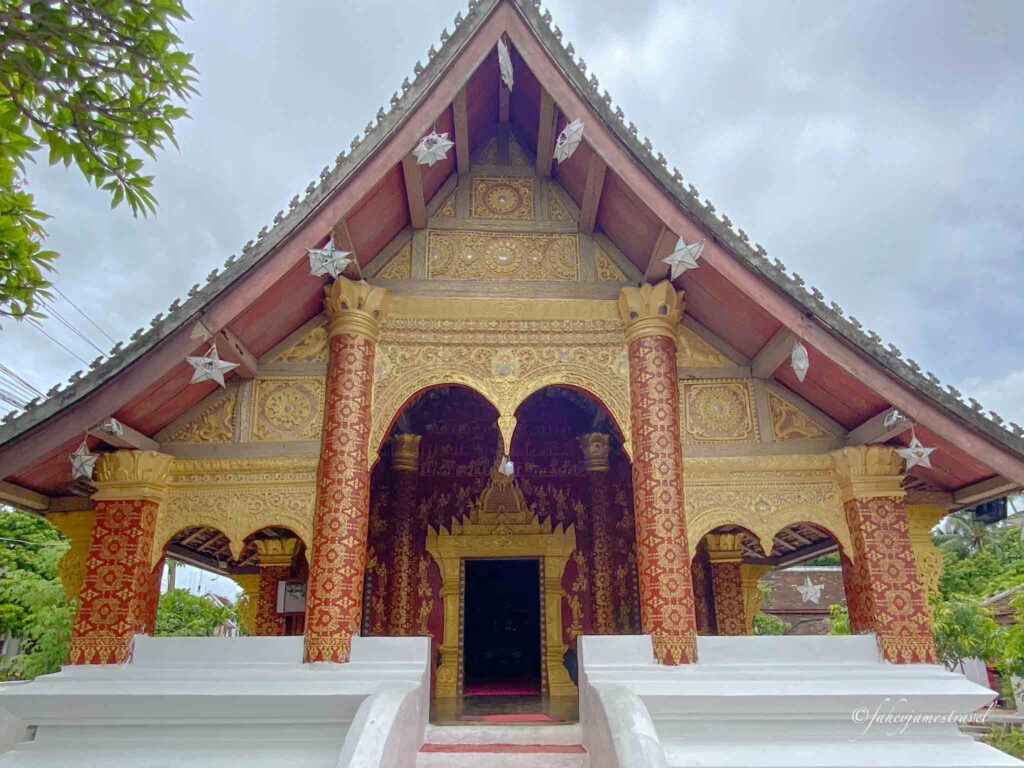
I fell in love with the ceiling and the gold and red colours as you came to the entrance.
There is a unique sense of calm at all the temples in Luang Prabang, and Vat Sibounheuang is something special.
You can embrace the aura of the monks as they will undoubtedly be walking around the temple, and the aroma of incense will add to the atmosphere of calm.
I was impressed with the long wooden Naga hanging in the temple. It was enormous, and I can’t remember seeing one of that size throughout my time in Southeast Asia.
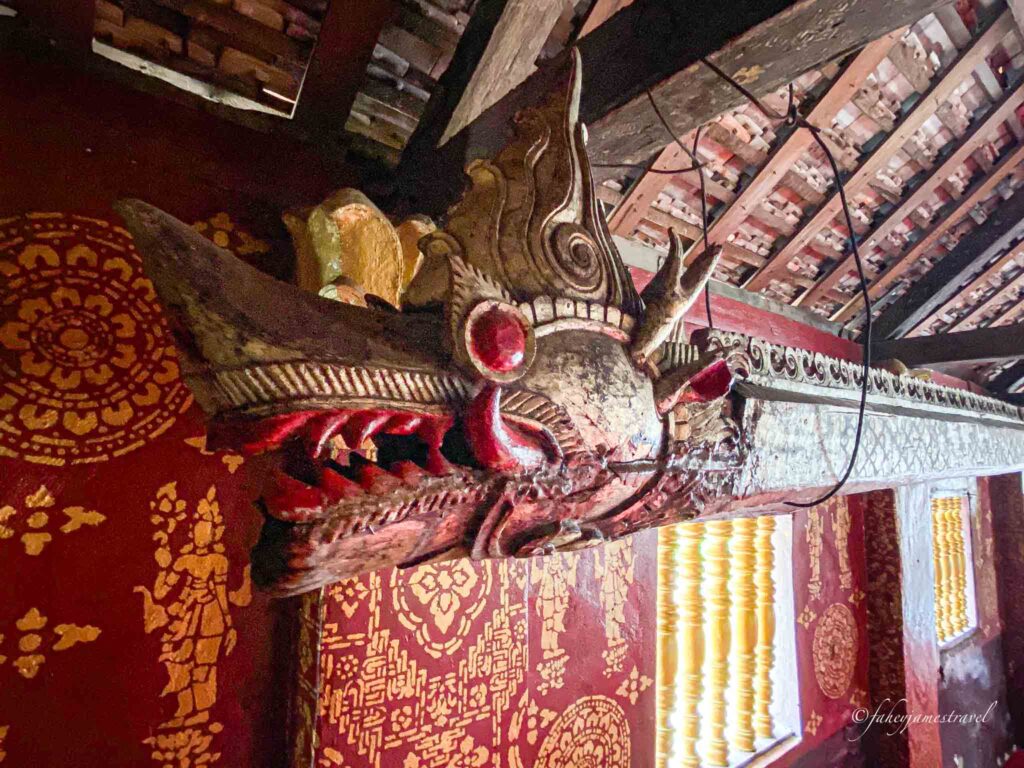
When I visited around lunchtime, there were a few others, but nothing to be a pain.
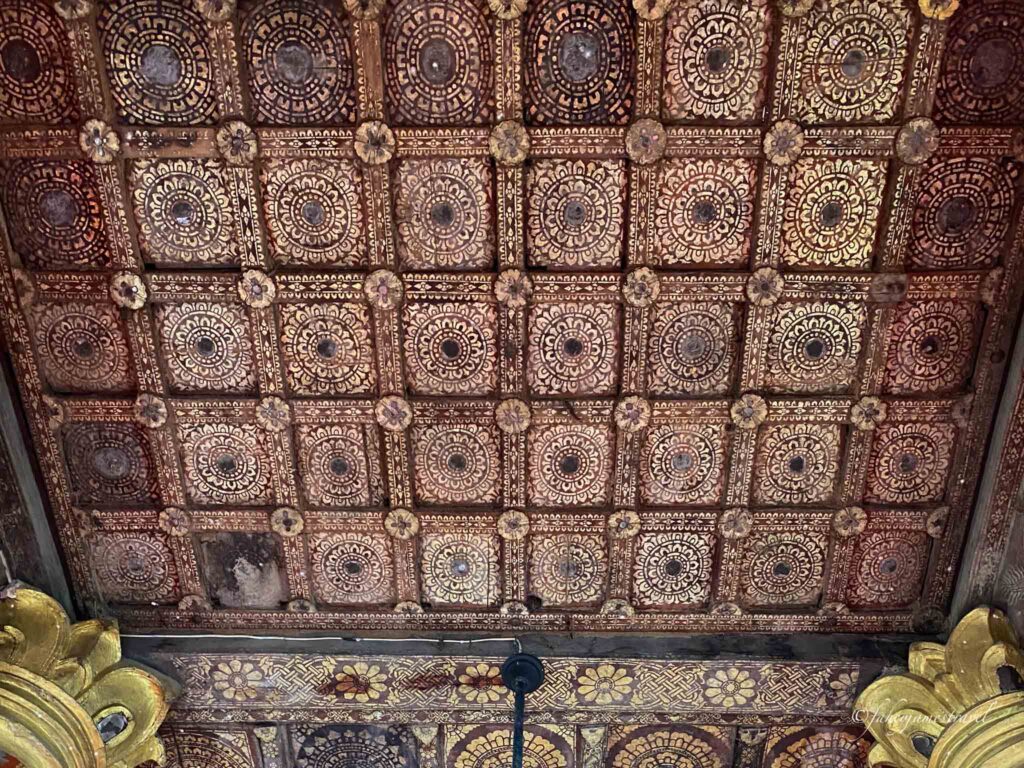
The main reason I would revisit is because of the beautiful roof inside, which has a dark red and gold design, and it catches the eye.
A 1-minute walk from the vat is the Buddhist Archives of Luang Prabang, a treasure trove for Buddhist history and culture.
- Opening Times: 08.00 AM – 05.00 PM
- Suggested Duration: 30 minutes
- Cost: Free
- Address: V4WV+G5Q, Luang Prabang, Laos
Find The Best Restaurants In Luang Prabang
Vat Xieng Thong
Vat Xieng Thong, aka the Golden City Monastery, is one of my favourite temples in all of Luang Prabang and the most famous.
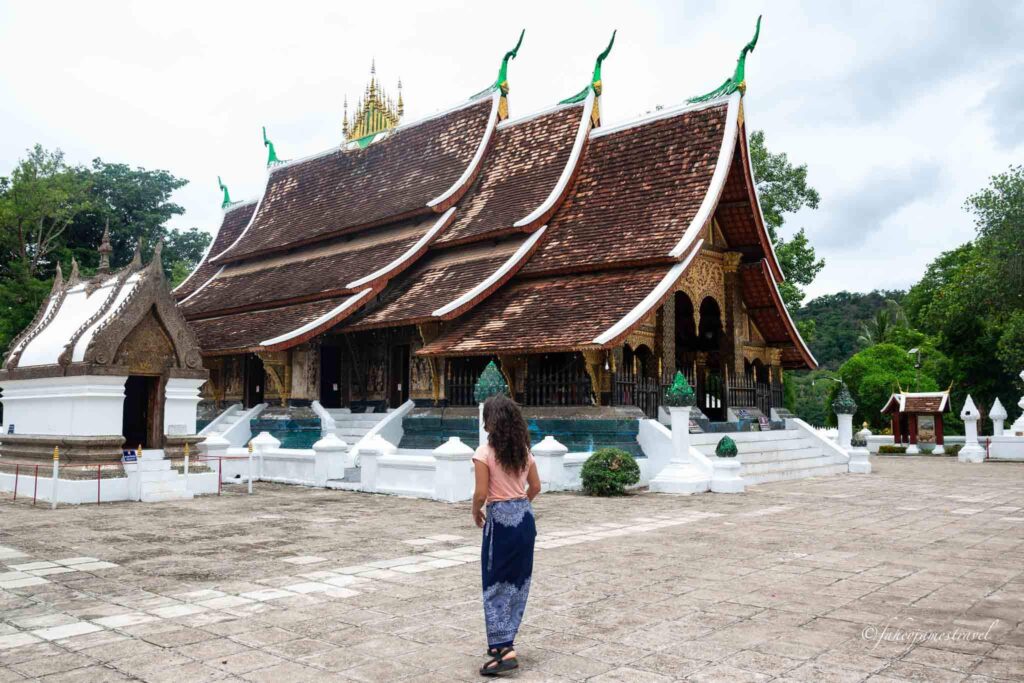
The complex is big. You can enjoy the best-looking detail and architecture which the city has to offer.
On our way in, I was impressed with the beautiful staircase with trees lining both sides.
This was the busiest temple I have been to, along with Phousi Temple. Vat Xieng Thong was built between 1559 and 1560 by King Setthathirath. When I entered the centre of the complex, it blew me away.
It is located 300 metres from the Nam Khan River, and locals call it the most beautiful and one of the oldest temples in the city.
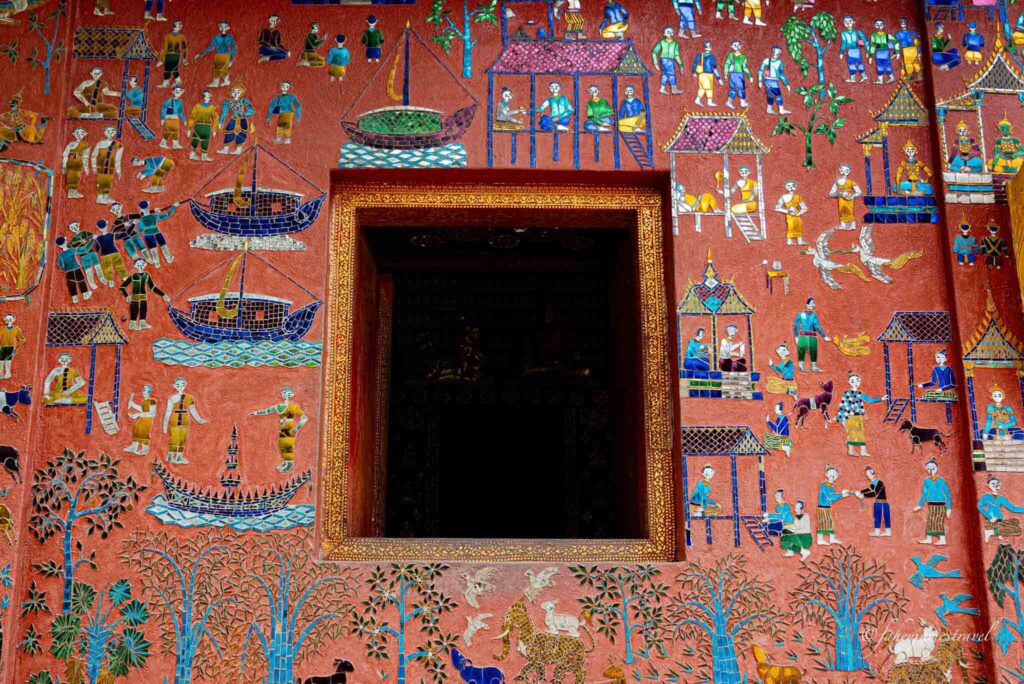
The temple owes much of its survival to King Sisavangvong and Sisavang Watthana, who both took a personal interest in its upkeep, with monk Kham Mao overseeing the restoration work that kept it standing.
Its rich history and cultural significance make it an essential landmark to visit.
You can get a guide to bring you around the temple to get a deeper insight into the history of the temple.
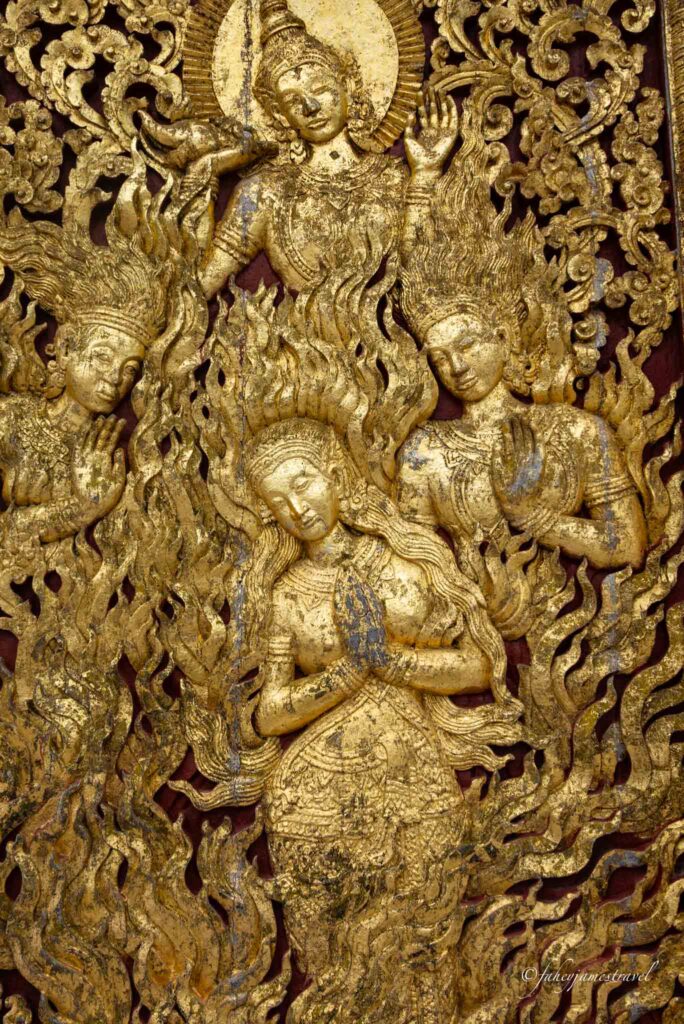
When I visited at around lunchtime, there were another 10 or so people walking the complex. It did not feel crowded, and it was nice to hear others around.
Don’t miss out on visiting the Royal Carriage House in the same complex. See the funeral carriage of King Sisavang Vong (1885-1959), King of Luang Prabang, 1904-46, and King of Laos.
It is a masterpiece of Laotian construction and architecture.
- Opening Times: 06.00 AM to 06.00 PM
- Suggested Duration: 1-1.5 hours
- Cost: 30,000 KIP ($1.33/€1.16/£1.00)
- Address: V4XV+277, Khem Khong, Luang Prabang, Laos
Haw Pha Bang
Haw Pha Bang is another temple worth visiting in Luang Prabang.
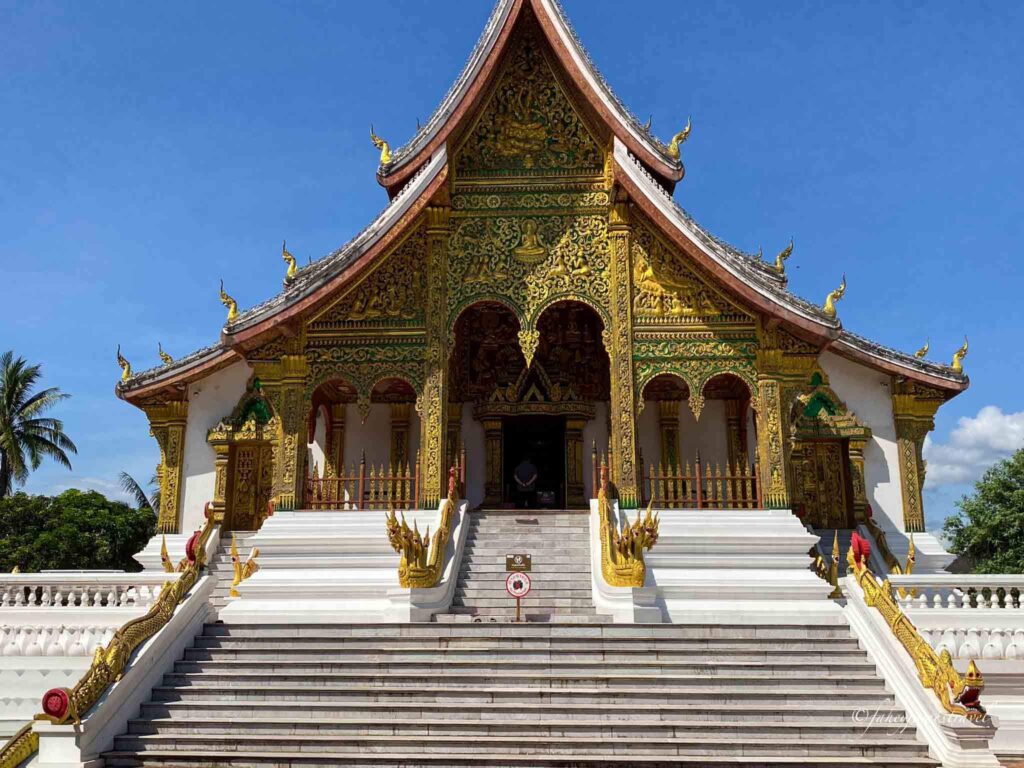
Located within the Royal Palace complex in Luang Prabang, I found it to be the best-maintained temple and one of the most impressive architecturally. Your ticket also includes access to the National Museum
While you can only look at the entrance of the temple, you can appreciate the detail and beauty of this golden temple. The handrails are exquisite Nagas and sparkle as you walk up the stairs.

The temple has an ornamental element consisting of 17 spires, consistent with temples throughout the country. While the palace was constructed in 1904 when the French were active in the region, the temple was started in 1963.
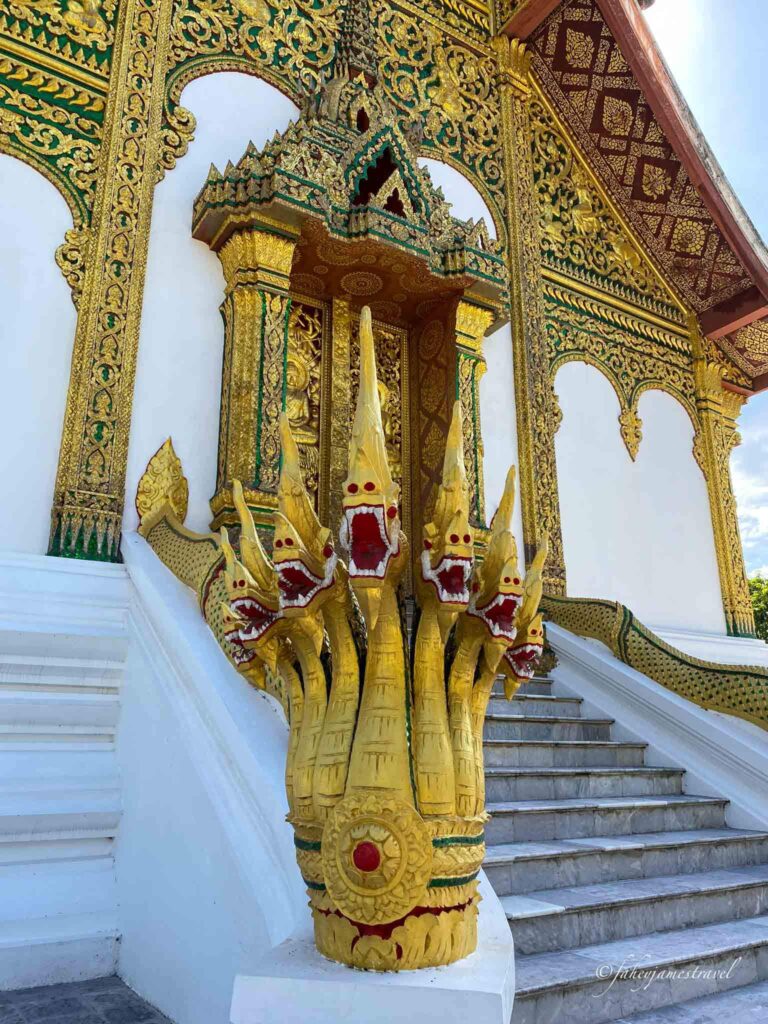
The central Buddha figure is the Prabang Buddha. According to legend, the Prabang was cast in Sri Lanka back in the 1st century AD, and it came to the city as a gift from the King of Khmer in 1359. Hence, the name changed to Luang Prabang in 1560 to honour the Buddha image.
If I had to visit one temple in Luang Prabang, Haw Pha Bang would be it.
- Opening Times: 08.00 AM –11:30 AM & 01:30 PM – 04.00 PM (last entry half hour before closing)
- Suggested Duration: 15-30 minutes
- Cost: 30,000 KIP ($1.33/€1.16/£1.00)
- Address: V4RP+MHC, Sisavangvong Road, Luang Prabang, Laos
Travelling In Laos? Find Out How To Travel To Luang Prabang Railway Station
Vat Chom Si
Vat Chom Si is located on Phousi Hill and has the best view from any temple in Luang Prabang.
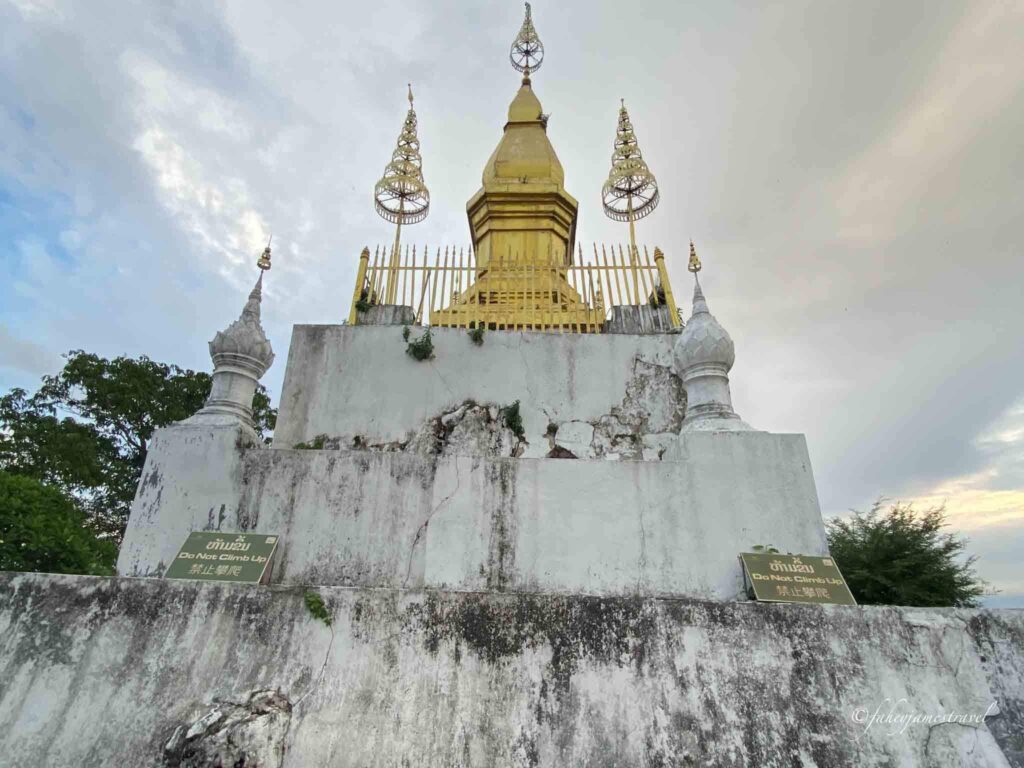
The temple is situated on top of Phousi Hill, and it takes 355 steps up to get there from the Nam Khan River route or 328 from the Royal Palace route.
When I got to the top, I spent most of the time gazing down upon the Mekong River on the north side and the Nam Khan River on the east side.
The climb to the top of the hill is challenging but doable.
I took a number of breaks going up, and you can find fun things to explore, such as a Buddha footprint, a golden stupa, Wat Tham Phousi, and a Roadside Shrine.
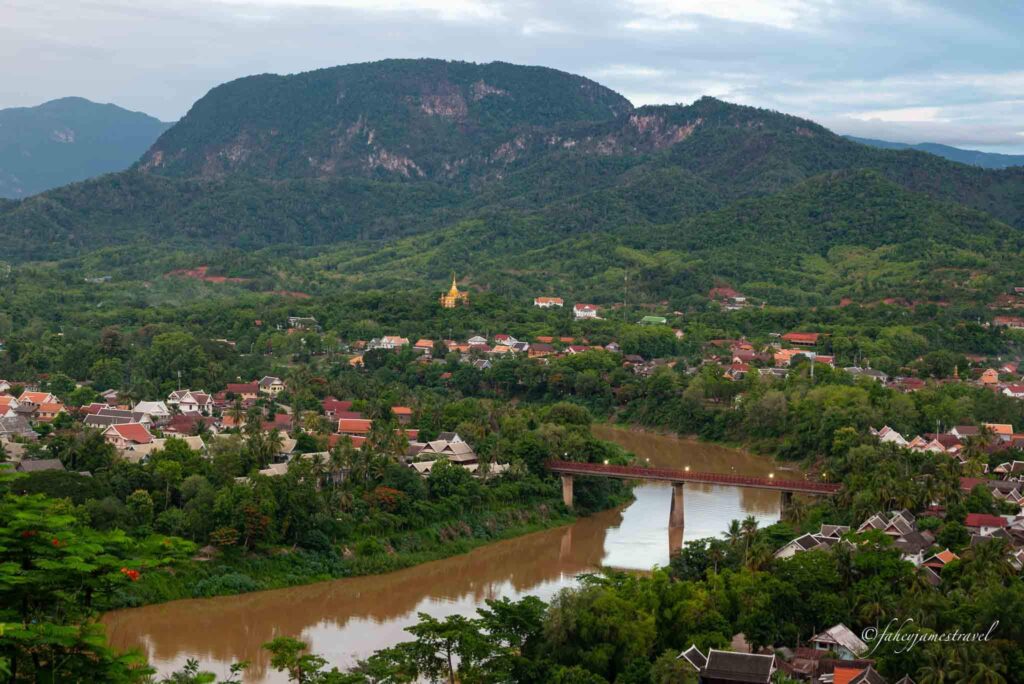
It gets very busy at sunset, so there will be competition for the best seat to view the sun falling away behind the mountains. I did not enjoy the jostling with other visitors.
The temple itself is nice but less attractive than the other Luang Prabang temples. It is an example of traditional Laotian architecture.
I loved exploring the complex and admiring the intricate carvings and decorations throughout.
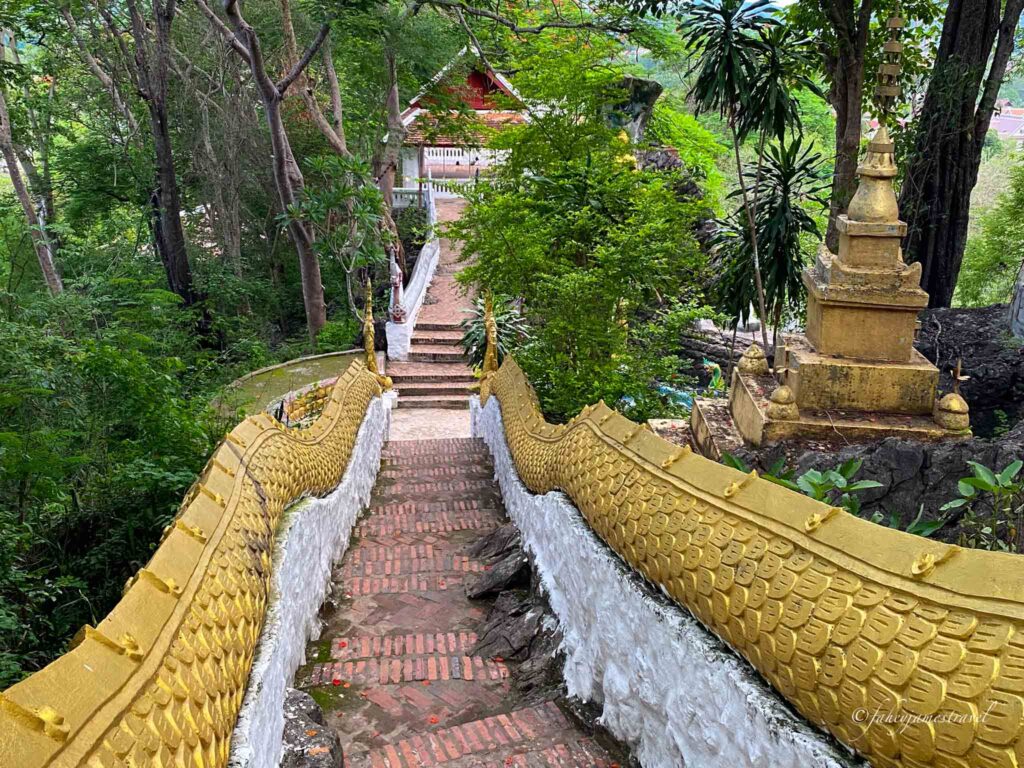
The temple is also home to several important Buddhist relics, so you can spend time walking the paths above the city and discovering these relics around the hilltop before you get to the main attraction.
We climbed up the ascent up a zig-zag path on Kingkitsarath Road beside the Nam Khan River but made the descent down via the second route, where we arrived on the roadside right beside Haw Pha Bang on Sisavangvong Road.
Both routes are manageable for people of all fitness levels. There is a public toilet, if needed, on the way up, found here.
There will likely be no crowd if you go earlier in the day.
- Opening Times: 06.00 AM – Sunset
- Suggested Duration: 2 hours
- Cost: 20,000 KIP ($0.89/€0.78/£0.67)
- Address: V4RP+3R Luang Prabang, Laos
Visit Kuang Si Falls Close To Luang Prabang
Wat Siphoutthabat Thippharam
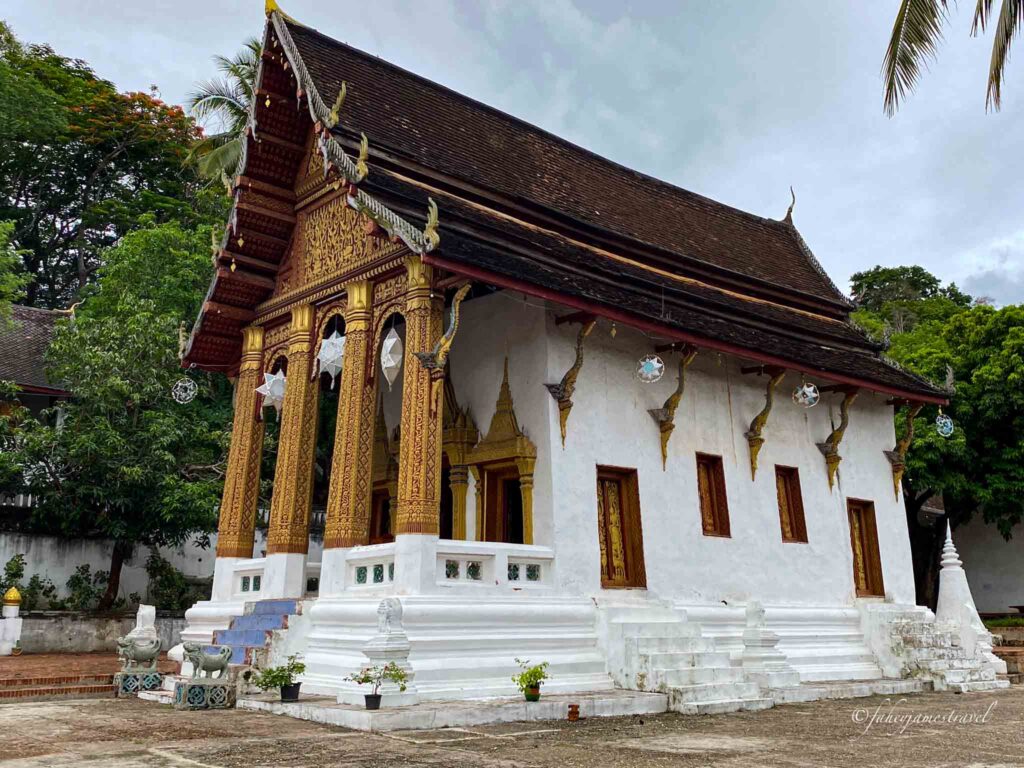
Wat Siphoutthabat Thippharam is found at the foot of Phousi Hill.
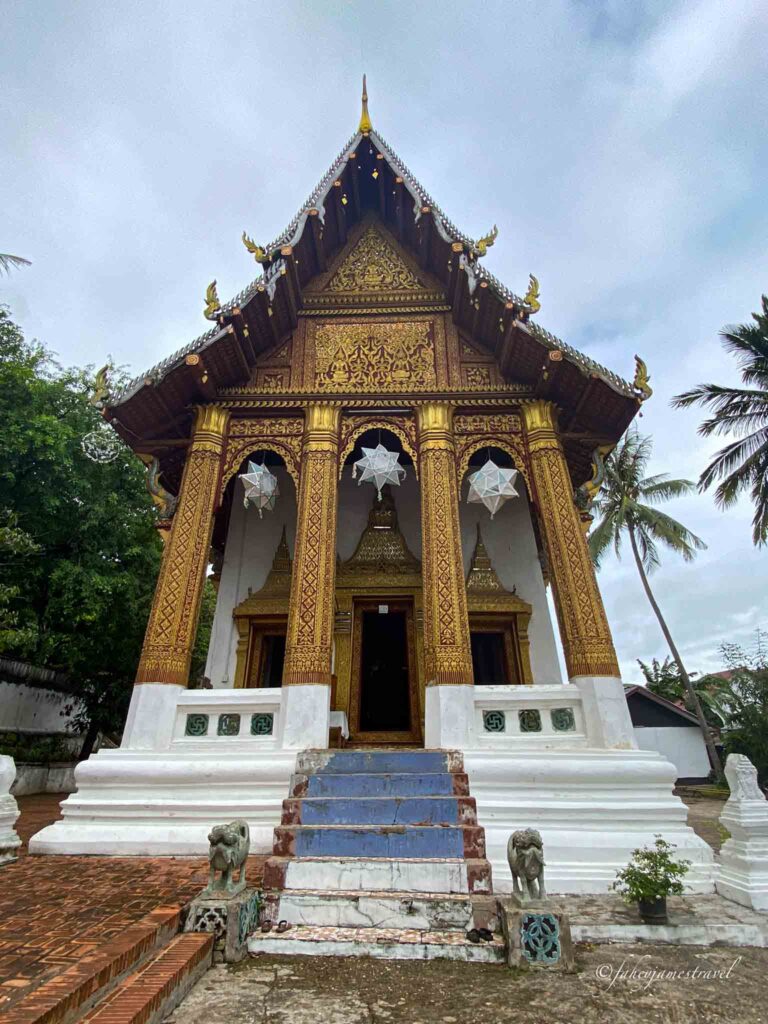
The name translates to “the Buddha’s footprints,” relating to the footprints I mentioned earlier on the way to Phosui Hill.
When I visited, I found it to be busy at 10.30 AM. This was likely due to its location. Close to Sisavangvong Road, which has lots of activity.
I was able to photograph a number of monks who were cleaning the temple, and they smiled at me as they kept on working.
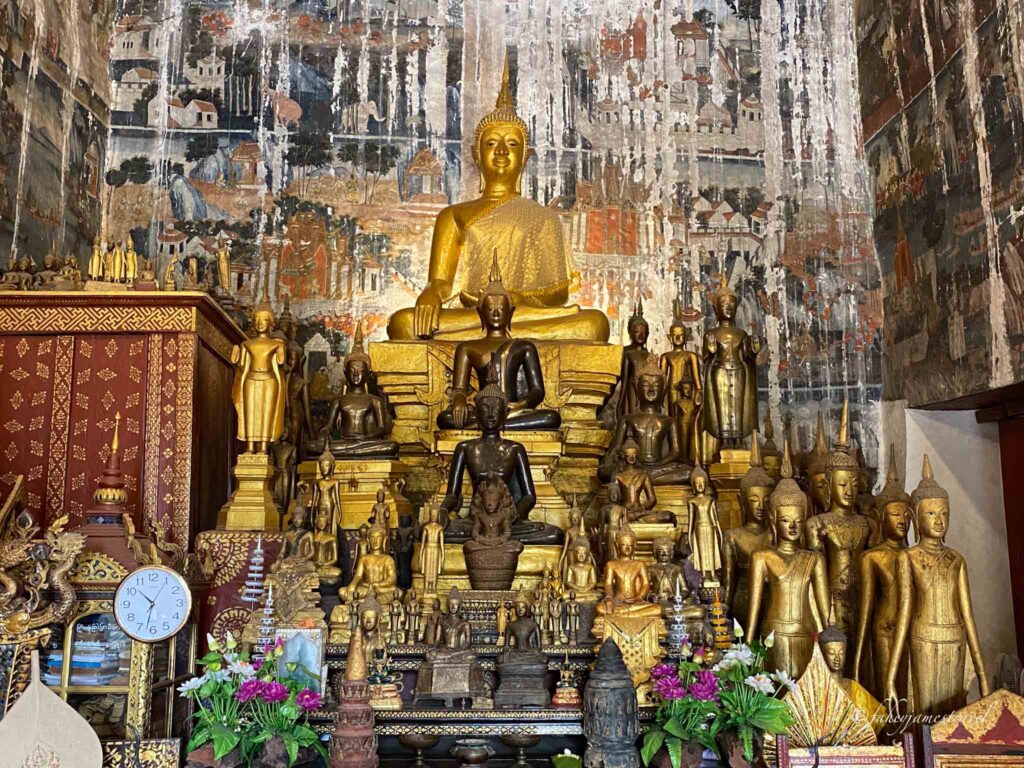
Inside, I found some golden and black Buddha statues and the floor had a giant red carpet and mural design, which was matched by the roof for design and detail.
Looking at the temple from the side, it looks elevated, and it’s not big, but the four pillars facing the entrance were the big winner for me. They reflected the golden and red colours.
Go first thing in the morning to have only you and the monks.
Later in the morning, it gets busier as it’s a nice stop before or after climbing Phousi Hill, and it attracts people for that reason.
Walk the small alleyway onto the street for some coffee. I recommend going to Rosetta Cafe, as it’s close by and has nice coffee from 29,000 KIP.
- Opening Times: 06.30 AM – 05.00 PM
- Suggested Duration: 30 Minutes
- Cost: Free
- Address: V4RP+3R Luang Prabang, Laos
Are Visiting The Luang Prabang Temples Worth It?
There are loads more temples to explore in Luang Prabang apart from my 8, but I do think these are worth your time.
The design, history and proximity to each other make for a trip to see many ancient temples. If you’re coming into the city from the Luang Prabang Railway Station, I have a full guide on that.
There are many great things to do in Luang Prabang, including the temples.
Thanks for reading,
James
FAQs
Is Luang Prabang Worth Visiting?
Luang Prabang is certainly worth visiting. I will be honest, the temples were my main attraction, but I decided to stay longer because life was far slower here than in Pakse or Vientiane. Besides the temples, tourists can visit the Luang Prabang night market, enjoy the Luang Prabang nightlife and grab a coffee in one of the many Luang Prabang cafes, which are sprawled throughout this wonderful city.
How Many Temples Are There In Luang Prabang?
There are currently 33 temples located in this city. I couldn’t say every temple is worth a visit because I didn’t see them all. Visitors to Luang Prabang can take a tour of the temples and learn more about the city’s rich cultural heritage. It is hard to visit them all on one trip.
What Is The Most Famous Temple In Laos?
Wat Xieng Thong is the most famous temple in Laos. The mosaic tree of life design on the rear wall is what sets it apart visually for its natural beauty. An honourable mention to Wat Phou and Haw Pha Bang, but my favourite was probably Wat Xieng Thong.
- My Two Weeks In Cambodia Itinerary (From Someone Who Spent Nearly A Month There)
- How To Visit Angkor Wat In 2026
- Best Restaurants In Siem Reap: Where To Eat And What To Order
- Where To Stay In Siem Reap In 2026 (Neighbourhoods And Hotels)
- 3 Days In Siem Reap, Cambodia (And What I’d Skip)


Loved this post., Loads of useful information for visitors and it brought back happy memories of our time in Luang Prabang. We didn’t manage to spend as much time there as you did but we did get to visit some of the temples you mentioned. Vat Xieng Thong was our favourite. Very sad to hear about the lack of respect from tourists at the alms giving ceremony.
There are all really beautiful temples! I love Vat Xieng Thong’s top – the green spikey things haha. I still can’t believe that tourists are not respectful – like it’s not hard to see the significance of these temples, treat them nicely and respect others’ traditions! I’d love to visit and learn more about the traditions and the different temples.
All the temples are stunning but I think Vat Sibounheuang is my favourite. Great post full of helpful information to allow a visitor to make a short list, if they have limited time.
I always suffer second-hand shame when tourists act disrespectfully. I can’t imagine how they justify such behaviour.
Lyn | http://www.ramblynjazz.com
Great info on the main Temples here. They are all beautiful and unique in their own way from Nagas to funeral carriages.
Laos is one of the countries I missed off in my S E Asia tour as I found it difficult to get to back 5 years ago, but I clearly have missed some wonderful sights.
It’s always difficult to chose which temples, churches, mosques to visit when one place has so many and to avoid religious site overload. These look like great choices.
Wow, 33 temples is an impressive number, and how great to see that a lot of them don’t cost anything to visit. I do enjoy exploring temples, they’re always so vibrant and full of unique carvings and details. I would happily explore many of these, until you inevitably get to the “templed out” point as in many SE Asia trips though. A good reason to save some for another day and spread out your visits – and spend longer in such a beautiful place
What a wonderful place, rich in spirituality and culture. I am always fascinated by places like this, so different from what we westerners are used to as places of worship.
Once again the post is very well organized, with extremely useful content.
I am still amazed when I hear reports of tourists who do not know how to behave when traveling. Once and for all people have to learn to respect the places they visit.
First, I haven’t been to Laos and second, there’s no excuse as to why I haven’t visited it yet. Temple visiting is one of those important ingredients to an enriching trip to southeast Asia – both culturally and spiritually. Anyone heading to Laos will find this post a helpful guide in navigating temples and tourist behavior. Thanks for taking me to Luang Prabang James. Awesome photos! #flyingbaguette
Jan – https://flyingbaguette.com/
First, I haven’t been to Laos and second, there’s no excuse as to why I haven’t visited it yet. Temple visiting is one of those important ingredients to an enriching trip to southeast Asia – both culturally and spiritually. Anyone heading to Laos will find this post a helpful guide in navigating temples and tourist behavior. Thanks for taking me to Luang Prabang James. Awesome photos! #flyingbaguette
Jan – https://flyingbaguette.com/
Haw Pha Bang is so beautiful! I love all the details in gold, and I agree (based on your list here) that it’s the one of the best maintained and one of the most impressive architecturally. But I do love a good climb and would probably check out Vat Chom Si, too. It’s so disappointing that some tourists couldn’t show respect and behave properly.
Temples, the churches of Asia 😀 I’m not too sure I would be engaged for all 8 temples but I can appreciate the intricate details. I particularly like the dragon symbols and decorations around the building. Ha Pha Bang would definitely be of interest to me here but also no surprise to read that it is one of the popular temples and therefore maintained well. Keep exploring James!
Carolin | Solo Travel Story